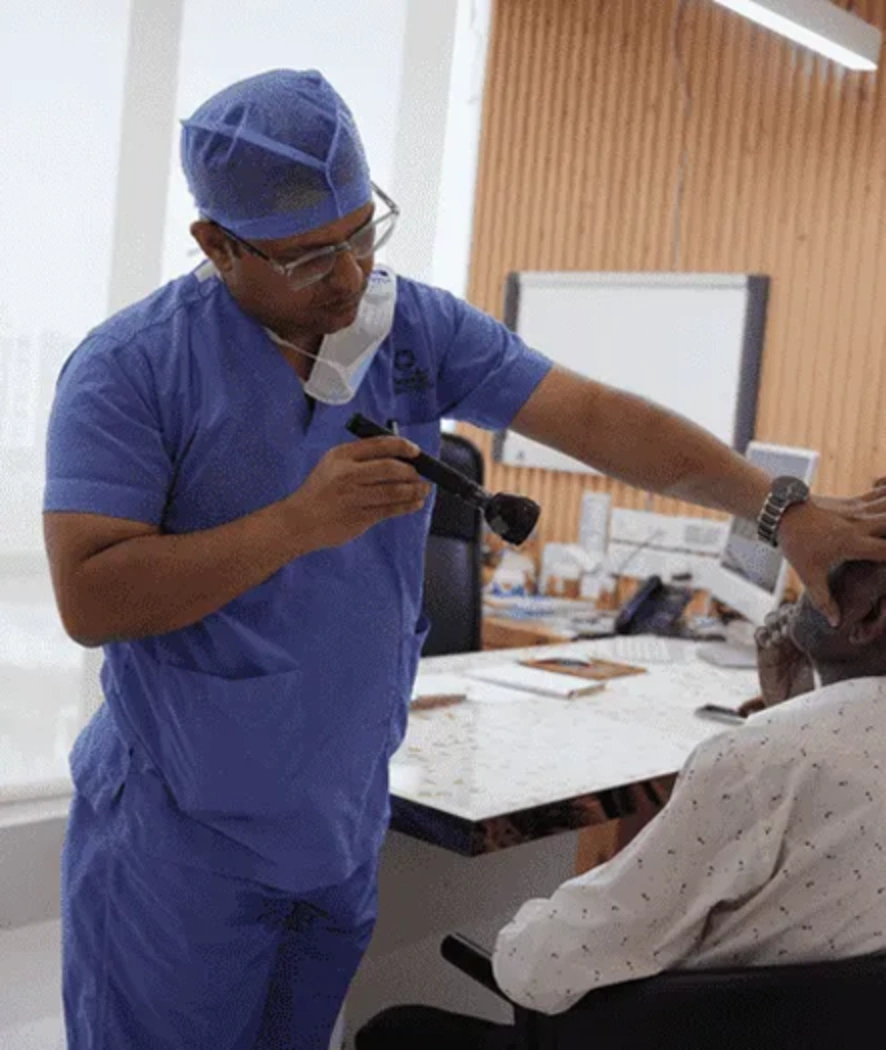

Reviewed by Dr. Amit Chakraborty, Head & Neck Cancer Specialist, Registered Medical Practitioner: 2008113798
Key Takeaways
- Cancer in the voice box (larynx) is called laryngeal cancer, and if it is on the vocal cords it is also called as vocal cord cancer.
- If your voice stays hoarse for more than 3 to 4 weeks get your throat checked, as this is the most common early sign.
- Smoking, bidi and drinking are the main reasons behind it and doing both together makes the risk much higher.
- For early cancer mostly one treatment is enough, like radiotherapy or laser surgery, and a lot of patients get to keep their voice.
- Advanced cancer may need chemo along with radiation or the voice box may need to be removed (laryngectomy), it depends on how far it has spread.
- Don’t stop or delay your treatment and don’t change medicines by yourself without your doctor’s advice.
- Noisy breathing, difficulty in breathing or coughing blood means you need to rush to the hospital emergency.
In India, cancer of the voice box is mostly seen in men, making up around 3 to 6% of all cancers in men (Bobdey et al., 2015). Some people are diagnosed only after symptoms have been present for months, which can delay treatment. So if a hoarse voice stays, it should not be dismissed as just a throat infection or because someone talked too much.
When the doctor says the word “cancer of the voice box’, most patients get scared and the first thing they ask is, ‘Will I be able to talk again?’ Now the answer depends on a lot of things like which part of the voice box has the cancer, what stage it is in and how your overall health is. Good thing is that many people with early cancer still keep their own voice after the treatment.
In this blog we will tell you what laryngeal cancer is, what are the laryngeal cancer symptoms, how vocal cord cancer is staged, what treatment options are there for larynx cancer and how Dr. Amit Chakraborty can help you with it.
Is your voice hoarse for more than 3 weeks?
What Is Laryngeal Cancer?
Laryngeal cancer is the cancer that occurs in your larynx. The larynx is what we call the voice box and you can find it in front of your neck just above the windpipe. Almost always this cancer starts from the thin flat cells lining the voice box from inside, so doctors name it squamous cell carcinoma.
To understand it in easy terms, the larynx has three parts to it. The top part above the vocal cords is called supraglottis, the middle part where your vocal cords are is the glottis and the part below the cords is the subglottis. If the cancer starts on the vocal cords then it is also called as vocal cord cancer or glottic cancer.
Cancer on the vocal cords changes the voice very early, so people notice it sooner. But cancer in the upper part may not change the voice in the start and it can reach the lymph nodes of the neck before anyone finds it. Laryngeal cancer comes under head and neck cancer and since it is very close to the lower throat, people sometimes call it throat cancer also.
Laryngeal Cancer Symptoms
In the beginning the laryngeal cancer symptoms are mild and there is usually no pain, which is why a lot of people ignore them. Following are the symptoms you should keep a watch on:
| Symptom | What you may notice |
| Hoarseness or change in voice | Rough, weak or breathy voice which is not getting better even after 3 to 4 weeks |
| Sore throat | Pain or discomfort which keeps coming back |
| Difficulty or pain while swallowing | Food feels stuck or it hurts when you swallow |
| Ear pain | Pain in one ear, but the ear itself looks normal |
| Lump in the neck | A painless swelling which is not going away |
| Cough | Long-standing cough, sometimes with blood |
| Breathing changes | Noisy, high-pitched breathing or feeling breathless, mostly in advanced cancer |
| Weight loss | Losing weight without trying |
Most of the time these symptoms come from an infection, acid reflux or straining the voice and it is not cancer. But if your voice is hoarse for more than 4 weeks, guidelines say the doctor should check your voice box with a small camera (laryngoscopy), and even earlier if they feel something serious is going on (Stachler et al., 2018).
| A hoarseness of voice that does not go away is also one of the first-stage throat cancer symptoms doctors look for. |
Causes and Risk Factors of Larynx Cancer
Larynx cancer happens when the cells of the voice box keep getting damaged for years and then start growing out of control. Following are the common risk factors:
- Smoking cigarettes or bidi, which is the biggest risk factor. Studies done in India found that smokers had around 1.5 to 7 times higher risk and bidi carried a higher risk than cigarettes (Bobdey et al., 2015).
- Drinking alcohol, especially along with smoking
- Working for years together around asbestos, paint fumes, wood dust or other chemicals
- Age above 55 to 60 years and being male, though women who smoke can also get it
- Poor diet with very less fruits and vegetables
- Long-standing acid reflux, which some studies link with it but the evidence is not strong
These are general points and just having a risk factor does not mean you will get cancer. Most of the throat cancer reasons are the same, only HPV plays a much smaller role in the voice box than in the tonsils and back of the throat.
How Is Laryngeal Cancer Diagnosed?
First the doctor will ask you about your symptoms and if you smoke, and then feel your neck to check for any lump. After that these tests are usually done:
- Laryngoscopy, in which a thin tube with a camera goes in from your nose so the doctor can see the voice box.
- Biopsy, in which a tiny piece is taken from the area while you are under general anaesthesia and it is sent to the lab to confirm if it is cancer.
- CT scan or MRI of the neck, which shows how deep the cancer has gone and if the lymph nodes in the neck have it.
- PET-CT or a chest scan in some patients, to see if it has reached other parts of the body.
The sooner you get these tests done the better it is, because you have the best chance to detect throat cancer early when the voice change is still new.
Stages of Vocal Cord Cancer
After understanding how it is diagnosed, you should know how laryngeal cancer is staged. Doctors use the TNM system for this.
T represents the size of the tumour and its growth, N indicates whether the cancer is present in the neck lymph nodes, and M shows if it has spread to distant organs like the lungs.
Below table explains each stage in simple words:
| Stage | What it usually means for you |
| Stage 0 | Abnormal cells only in the top lining, not cancer that has grown deeper yet |
| Stage 1 | Cancer only in one part of the voice box and vocal cords move normally |
| Stage 2 | Spread to a nearby part of the larynx, or the vocal cord is not moving fully |
| Stage 3 | Vocal cord is fixed or cancer has reached one small lymph node on the same side |
| Stage 4A | Spread outside the voice box into the thyroid cartilage, thyroid gland or neck tissues, or more lymph nodes involved |
| Stage 4B | Very advanced local spread or large lymph nodes |
| Stage 4C | Spread to distant organs |
Stage 1 and 2 are called early laryngeal cancer and stage 3 and 4 are called advanced. Every part of the larynx has slightly different details, so your exact stage will be told by your doctor after seeing all your reports.
Laryngeal Cancer Treatment Options
The main aim of laryngeal cancer treatment is to remove the cancer fully and save your voice, breathing and swallowing wherever it is safe to do so. For this the surgeon, radiation doctor and medical oncologist plan it together (Steuer et al., 2017) and your plan will depend on your stage, which part of the larynx has the cancer and your general health.
Treatment for early laryngeal cancer
For early cancer usually one treatment is enough. The options are:
- Radiotherapy, where high energy rays are given to the voice box for around 3 to 7 weeks, depending on the treatment plan. Radiation therapy for head and neck cancer is planned so that the healthy tissue around gets as little dose as possible.
- Transoral laser surgery, where the cancer is removed through the mouth with a laser without any cut on the neck.
- Partial laryngectomy, where only the affected part of the voice box is removed and the rest is kept.
| There is a Cochrane review on this topic which says we still do not have enough good evidence to tell if radiotherapy or surgery is better for early larynx cancer (Warner et al., 2014). So the choice depends on where exactly the cancer is, how your voice will be after each option and what suits you practically, and it is completely fine to ask the doctor to explain both to you. |
Treatment for advanced laryngeal cancer
In advanced cancer you will usually need more than one treatment. Following are the main options:
- Chemotherapy along with radiation (chemoradiation) to treat the cancer and try to keep the voice box. A long-term study on around 520 patients found that cisplatin chemo given along with radiation saved the voice box better than radiation alone or chemo given before radiation, but there was not much difference in overall survival (Forastiere et al., 2013).
- Surgery to take out the whole voice box (total laryngectomy) and mostly radiation after it. Doctors generally advise this when the cancer has destroyed the cartilage or the voice box is not working anymore.
- Neck dissection, where the lymph nodes of the neck are removed if the cancer has reached them or the risk of spread to them is high.
| There was an older study on 332 patients where chemo and radiation were tried first and surgery was done only for those who needed it. In this group the larynx was saved in 64% patients and 2-year survival was 68%, same as the patients who had surgery first (Department of Veterans Affairs Laryngeal Cancer Study Group, 1991). |
This shows saving the voice box is possible for a lot of patients, but it does not suit every advanced cancer, so your doctor will compare the surgical options for throat cancer with chemotherapy and radiation and then decide.
When the cancer comes back after radiation, surgery is often done next. If it has reached far organs your doctor may give chemotherapy, immunotherapy or targeted therapy to control it and keep you comfortable. Difference between chemotherapy, targeted therapy and immunotherapy is mostly in how they attack the cancer cells.
| Expert Insight “Patients and families usually ask me in the first meeting if they will lose their voice. What I always tell them is that we first find out exactly where the cancer is and how far it has gone, and only then we decide. Many early cancers can be treated while keeping the natural voice, and even when the voice box has to be removed there are good ways to speak again.” Dr. Amit Chakraborty MBBS, MS, MCh (Surgical Oncology), MRCS (UK) Head & Neck Cancer Specialist Registered Medical Practitioner | 2008113798 |
Life After Laryngeal Cancer Treatment
After radiotherapy your throat can feel sore and dry and the voice may stay weak for few weeks. These radiation side effects in head and neck cancer get better slowly over a few months.
If the whole voice box is taken out, you will breathe from a small hole in front of your neck (stoma) for life. Normal speaking will not be possible after this, but most people learn speaking after laryngectomy with a speech therapist by using an electrolarynx, a voice prosthesis or oesophageal speech.
Following are a few things which help during recovery:
| Do go for all follow up visits since the doctor will keep checking your voice box with a scope for the first few years. Stop smoking and alcohol fully because if you continue, the cancer is more likely to come back. Start working with a speech and swallowing therapist from the beginning. Eat soft food with good protein, drink enough water and follow the dietary tips for head and neck cancer treatment that your dietitian gives. |
These are general points so your doctor may change them as per your condition. Throat cancer survival rate is a lot better when it is caught early, which is one more reason not to ignore a hoarse voice.
When to See a Head and Neck Cancer Specialist
| When to Get Medical Advice Meet the doctor if your voice is hoarse for more than 3 to 4 weeks, more so if you smoke or drink. Do not wait also if it hurts to swallow, there is pain in one ear, a lump in the neck or you are losing weight without trying. If there is noisy breathing, trouble in breathing or you cough up blood, go to the hospital emergency at once. |
Dr. Amit Chakraborty, Head & Neck Cancer Specialist (MBBS, MS, MCh Surgical Oncology, Registered Medical Practitioner: 2008113798), says that when voice box cancer is caught early it is usually much easier to treat, so hoarseness should be checked in the first few weeks and not after months. If you already have a diagnosis and want to be sure about your plan, you can take a second opinion as well.
Worried about a voice change or a laryngeal cancer diagnosis?
This article is for general health education and is not a substitute for personal medical advice. Please speak to your treating doctor about your own diagnosis and treatment plan.
References
Bobdey, S., Jain, A. and Balasubramanium, G. (2015). Epidemiological review of laryngeal cancer: An Indian perspective. Indian Journal of Medical and Paediatric Oncology, 36(3), 154-160.
Department of Veterans Affairs Laryngeal Cancer Study Group, Wolf, G.T., Fisher, S.G., Hong, W.K., et al. (1991). Induction chemotherapy plus radiation compared with surgery plus radiation in patients with advanced laryngeal cancer. New England Journal of Medicine, 324(24), 1685-1690.
Forastiere, A.A., Zhang, Q., Weber, R.S., et al. (2013). Long-term results of RTOG 91-11: a comparison of three nonsurgical treatment strategies to preserve the larynx in patients with locally advanced larynx cancer. Journal of Clinical Oncology, 31(7), 845-852.
Stachler, R.J., Francis, D.O., Schwartz, S.R., et al. (2018). Clinical Practice Guideline: Hoarseness (Dysphonia) (Update). Otolaryngology Head and Neck Surgery, 158(1 suppl), S1-S42.
Steuer, C.E., El-Deiry, M., Parks, J.R., Higgins, K.A. and Saba, N.F. (2017). An update on larynx cancer. CA: A Cancer Journal for Clinicians, 67(1), 31-50.
Warner, L., Chudasama, J., Kelly, C.G., et al. (2014). Radiotherapy versus open surgery versus endolaryngeal surgery (with or without laser) for early laryngeal squamous cell cancer. Cochrane Database of Systematic Reviews, (12), CD002027.



 Aug 18, 2025