
Quick Answer: Yes, HPV can cause throat cancer, specifically HPV-positive oropharyngeal cancer, which develops in the tonsils and base of the tongue. It’s now the leading cause of this cancer in many countries, ahead of tobacco and alcohol.
Symptoms: A persistent, painless neck lump, sore throat, or swallowing difficulty lasting 2–3+ weeks.
Diagnosis: Clinical exam, imaging, biopsy, plus p16/HPV testing to confirm HPV status.
Outlook: HPV-positive throat cancer generally responds better to treatment and has better survival rates than HPV-negative throat cancer.
Prevention: HPV vaccination is the most effective protective step.
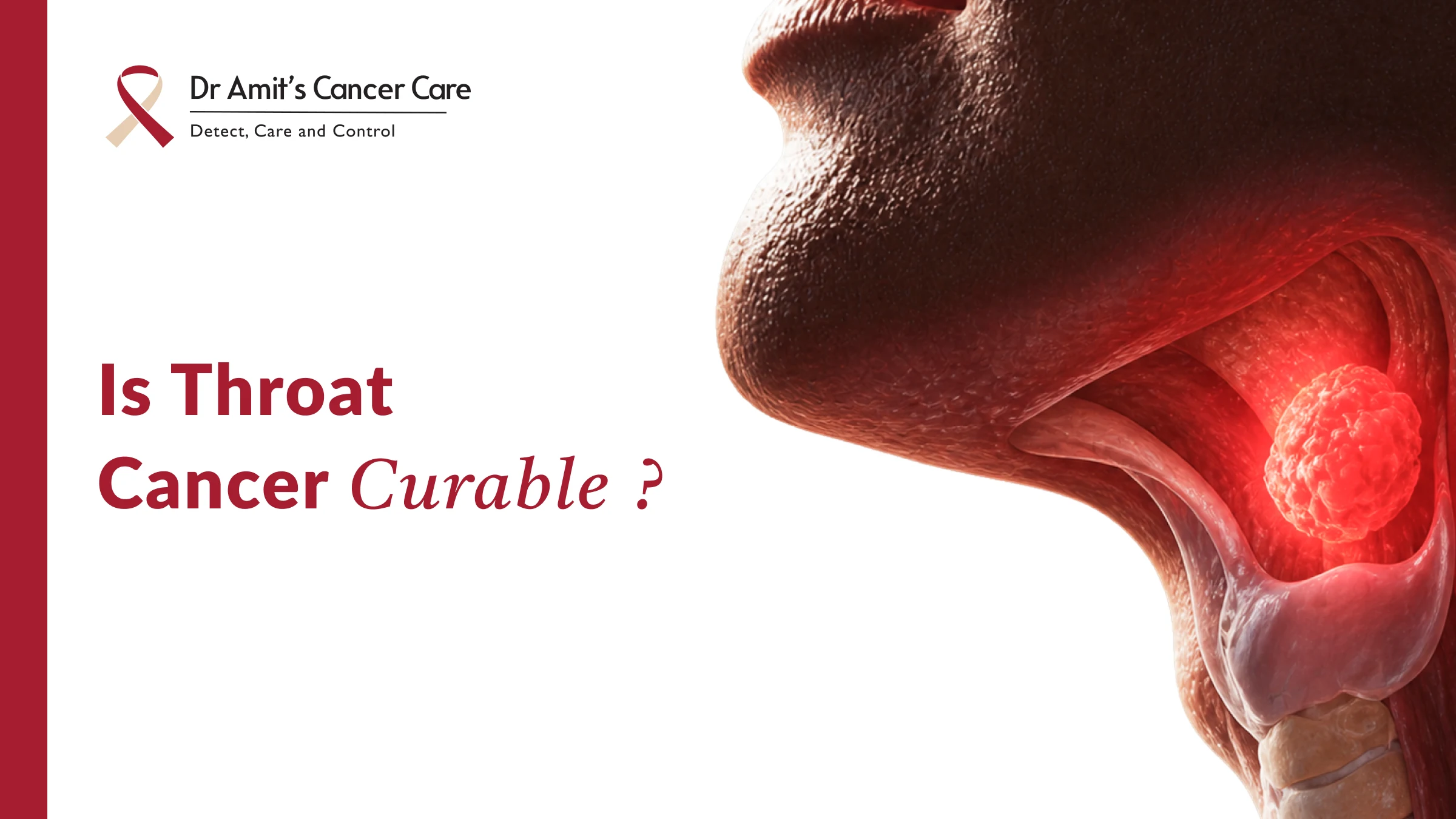
HPV (human papillomavirus) can cause throat cancer, specifically a type called oropharyngeal cancer, which develops in the tonsils, the base of the tongue, and the back of the throat. In many countries, HPV has now overtaken tobacco and alcohol as the leading cause of this particular cancer.
HPV is usually talked about in connection with cervical cancer, not the throat, but throat cancer has a specific link with HPV, and so it is important to understand exactly how this connection works and what it means for treatment. This guide covers what HPV throat cancer is, the evidence behind the link, the symptoms to watch for, how it’s diagnosed and treated, and whether it can be cured.
What Is HPV Throat Cancer?
HPV throat cancer, more precisely called HPV-positive oropharyngeal cancer, is a cancer of the throat that develops when a persistent infection with certain high-risk strains of HPV causes normal cells in the tonsils or base of the tongue to become cancerous. It’s identified as a distinct category because it behaves differently from throat cancers that develop quickly by smoking and heavy drinking.
The oropharynx is the middle part of the throat, situated just behind the mouth, and includes the tonsils, the base of the tongue, the soft palate, and the back and side walls of the throat. HPV is a very common virus that most people are exposed to at some point through oral contact, and in most cases the immune system clears the infection without any lasting effect. In some people, the infection persists in the throat tissue for years, and it’s this long-term, persistent infection that causes some cells to become cancerous.
Is There a Link Between HPV and Throat Cancer?
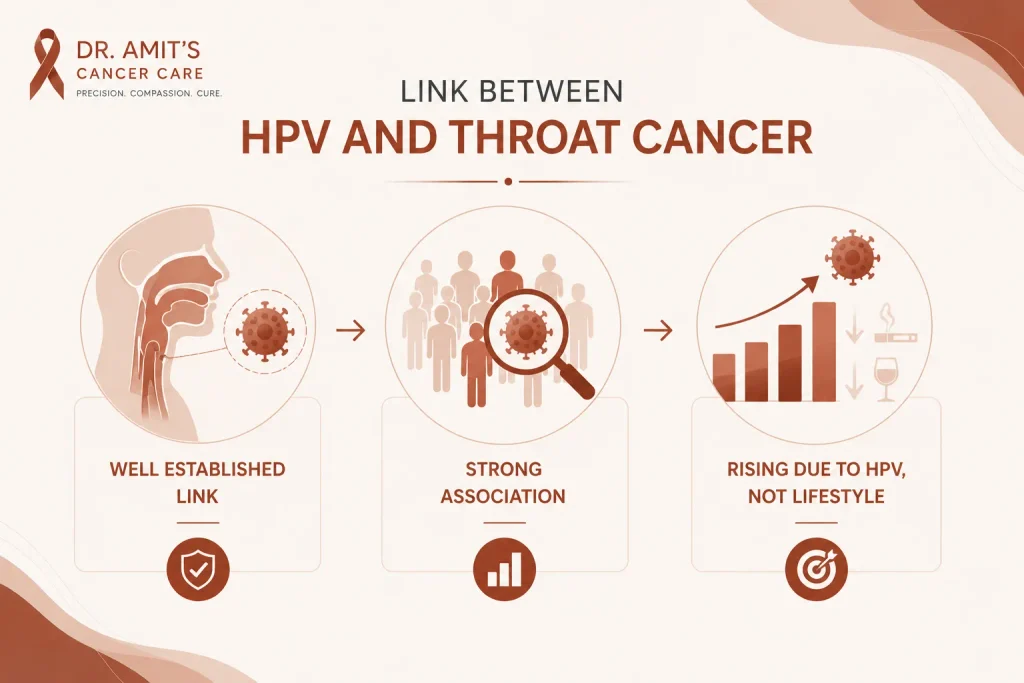
Yes, the link between HPV and throat cancer is well established, not a theoretical or emerging concern. Scientists have confirmed it through both laboratory evidence, showing how the virus changes cell behaviour.
One of the studies found that oral HPV infection was strongly associated with the cancer, even after accounting for smoking and alcohol use (D’Souza et al., 2007).
Another research states that the rising number of oropharyngeal cancer cases was closely tied to the rising prevalence of HPV infection in the tumours themselves, not to changes in smoking or drinking habits, which have actually been declining (Chaturvedi et al., 2011).
How Can HPV Lead to Throat Cancer?
| High-risk HPV infection ↓ HPV enters cells in the back of the throat, especially around the tonsils and base of the tongue. ↓ In most people, the body clears HPV naturally. ↓ But in some people, HPV stays in the body for many years. ↓ The virus starts interfering with the normal controls that keep cells healthy. ↓ Some cells begin to grow and divide when they should not. ↓ Abnormal cells build up over time. ↓ These changes can eventually turn into cancer. ↓ HPV-related throat cancer |
HPV usually does not cause throat cancer immediately. The concern is when a high-risk type of HPV stays in the throat for a long time and gradually causes changes in the cells. Most HPV infections clear on their own and never lead to cancer.
Together, this evidence is why HPV-positive oropharyngeal cancer is now recognised as its own distinct disease category, which is more common in young and healthy people who have very little or no history of tobacco use.
Symptoms of HPV-Related Throat Cancer
The most common early sign of HPV-related throat cancer is a persistent, painless lump in the neck, caused by cancer that has spread to a lymph node. This is one of the reasons it’s sometimes detected later than throat cancers linked to smoking, which tend to cause pain or hoarseness.
“The tricky part with HPV-related throat cancer is that it often doesn’t hurt. Patients come in because they noticed a lump while shaving or in the shower, and by then it may have already reached a lymph node. That’s exactly why a painless lump should never be dismissed just because it doesn’t hurt.”
— Dr. Amit Chakraborty
MBBS, MS – General Surgery,
MCh – Surgical Oncology MRCS (Royal College of London) UK
Other throat cancer symptoms include:
- A persistent sore throat or the feeling of something stuck in the throat
- Difficulty or pain when swallowing
- Unexplained ear pain on one side
- A change in voice that doesn’t resolve
- Unintentional weight loss
If any of these HPV-related early signs of throat cancer last more than two to three weeks, it is advised to have a proper examination because detecting throat cancer early is extremely important.
If you have a persistent sore throat, difficulty swallowing, unexplained ear pain, voice changes, or weight loss lasting more than two to three weeks, a specialist evaluation can help identify the cause early.
How Is HPV Throat Cancer Diagnosed?
Diagnosing HPV throat cancer involves a physical examination of the throat and neck, certain imaging tests to see the extent of the disease, and a biopsy to confirm both the cancer itself and whether HPV is actually driving it.
HPV throat cancer diagnosis includes the following:
| Test | What Happens |
| Physical Examination | Examination of the mouth, throat, and neck |
| Flexible Scope Examination | A thin, flexible scope is used to see areas that aren’t visible from outside. |
| Imaging | CT or MRI scan to map the size of the tumour and check nearby lymph nodes |
| Biopsy | Usually taken from the primary site or an enlarged lymph node |
| Cancer Confirmation | The tissue is tested to confirm the cancer diagnosis |
| p16 Testing | Checks for p16, a reliable indicator of HPV-driven cancer |
| HPV DNA Testing | Sometimes performed alongside p16 testing for confirmation |
HPV Throat Cancer Treatment
HPV throat cancer is treated with surgery, radiation, or a combination of the two, with chemotherapy added when the cancer is more locally advanced, and the specific combination depends on the tumour’s size, location, and how far it has spread.
For smaller, earlier-stage tumours, minimally invasive surgery such as transoral robotic surgery is often used to remove the cancer directly through the mouth to avoid a larger external incision. These surgical options are often used for other throat cancers as well.
For more locally advanced disease where the cancer has reached nearby lymph nodes or surrounding tissue, radiation combined with chemotherapy at the same time is a well-established standard approach, since the chemotherapy makes the cancer cells more responsive to radiation.
Because HPV-positive oropharyngeal cancer generally responds well to treatment, doctors are increasingly exploring treatment approaches for suitable patients, aiming to achieve similar cure rates with less intensive treatment and fewer long-term side effects. Treatment for throat cancer is within the broader field of head and neck cancer care and is closely related in approach to laryngeal cancer and hypopharyngeal cancer, which are situated nearby in the throat.
Is HPV-Related Throat Cancer Curable?
Yes, HPV throat cancer is curable, especially when it’s detected before it has spread widely. HPV-positive throat cancer consistently responds better to treatment and has better survival outcomes than throat cancer that isn’t linked to HPV.
Research found that those with HPV-positive tumours had significantly better overall survival than those with HPV-negative tumours, even when the cancers looked similarly advanced at diagnosis (Ang et al., 2010).
This doesn’t mean every case is straightforward. Outcomes still depend on the stage at diagnosis and how far the cancer has spread.
At the same time, there is still a lot of confusion around HPV and head and neck cancer. Understanding the common myths and the facts can help patients separate reliable medical information from misconceptions. You can read more about the myths and facts of HPV in relation to head and neck cancer to better understand the connection.
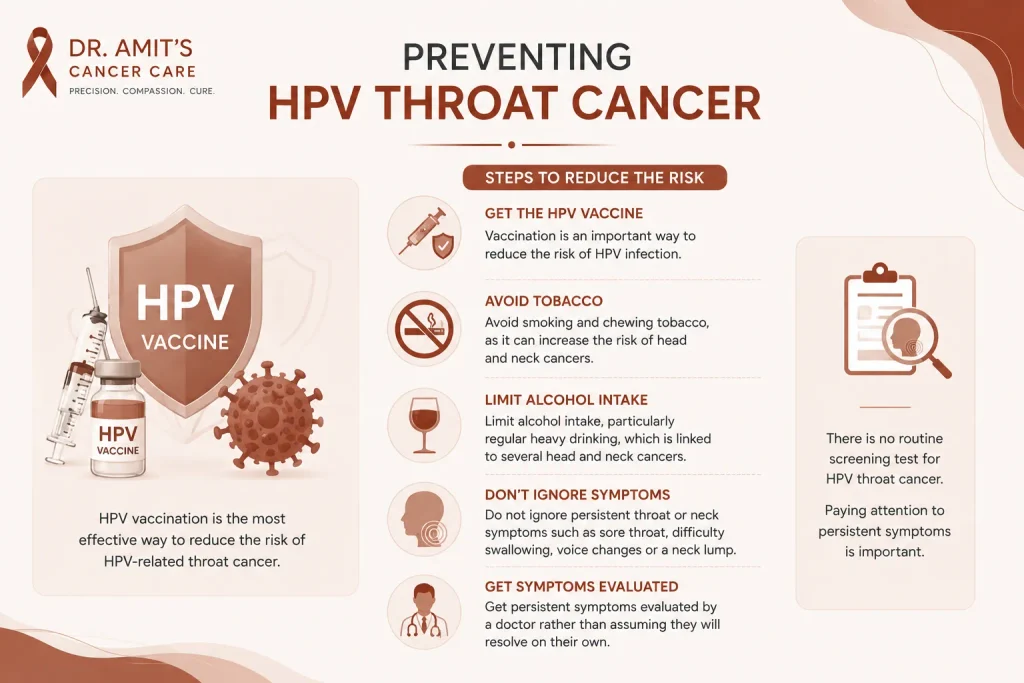
Preventing HPV Throat Cancer
HPV vaccination is currently the most effective way to reduce the risk of HPV-related throat cancer, since it protects against the high-risk HPV strains most strongly linked to this cancer. It’s most effective when given in adolescence, though follow-up vaccination is available for many adults too.
Steps to Reduce the Risk of HPV Throat Cancer
- Get the HPV vaccine as recommended. Vaccination is an important way to reduce the risk of HPV infection.
- Avoid tobacco, including smoking and chewing tobacco, as it can increase the risk of head and neck cancers.
- Limit alcohol intake, particularly regular heavy drinking, which is linked to several head and neck cancers.
- Do not ignore persistent throat or neck symptoms, such as a long-lasting sore throat, difficulty swallowing, voice changes or a neck lump.
- Get persistent symptoms evaluated by a doctor rather than assuming they will resolve on their own.
The guide to throat cancer prevention at present does not include a routine screening test for HPV throat cancer the way there is for cervical cancer, which is part of why paying attention to persistent symptoms, rather than waiting for a screening result, is genuinely important here.
Learn more about HPV vaccination from Dr. Amit Chakraborty.
Questions to Ask Your Doctor About HPV Throat Cancer
If you’ve noticed a persistent symptom or have already been told HPV may be involved in a diagnosis, a few direct questions can help you understand exactly where things stand and what happens next.
Following are the questions you may ask your doctor about HPV and throat cancer:
- Is my throat cancer HPV-positive or HPV-negative, and how was that confirmed?
- Does being HPV-positive change my treatment plan or my expected outcome?
- What stage is the cancer at, and how far has it spread?
- Will I need surgery, radiation, chemotherapy, or a combination, and in what order?
- What side effects should I expect, and how are they managed?
- Should my partner or family know anything about HPV as a result of my diagnosis?
A doctor confident in your evaluation should be able to answer all of this clearly, tied to your specific test results and biopsy findings, not as a general explanation of HPV throat cancer.
At Dr. Amit Chakraborty’s consultation, you can go through these questions in the context of your own symptoms, test results, and treatment goals. With his experience in head and neck cancer care, he can help you understand exactly what your diagnosis means and what to expect from treatment.
Book a Consultation with Dr Amit Chakraborty
The only reliable way to know whether a throat symptom, a neck lump, or an existing diagnosis is related to HPV is a proper clinical evaluation, including imaging and biopsy.
Dr Amit Chakraborty is a cancer surgeon specialising in head and neck cancer and working as part of a multidisciplinary tumour board that coordinates surgical, medical, and radiation oncology for each patient.
If you’ve noticed a persistent neck lump, sore throat, or swallowing difficulty and would value an expert evaluation or a second opinion, book a consultation with Dr Amit Chakraborty to discuss your symptoms, get a proper evaluation, and understand your treatment options.
If you have a persistent throat symptom, neck lump, or swallowing difficulty, an expert evaluation can help determine whether further testing is needed and give you clarity about your treatment options.
References
D’Souza, G., Kreimer, A.R., Viscidi, R., Pawlita, M., Fakhry, C., Koch, W.M., Westra, W.H. and Gillison, M.L. (2007) ‘Case-control study of human papillomavirus and oropharyngeal cancer’, New England Journal of Medicine, 356(19), pp. 1944–1956.
Chaturvedi, A.K., Engels, E.A., Pfeiffer, R.M., Hernandez, B.Y., Xiao, W., Kim, E., Jiang, B., Goodman, M.T., Sibug-Saber, M., Cozen, W., Liu, L., Lynch, C.F., Wentzensen, N., Jordan, R.C., Altekruse, S., Anderson, W.F., Rosenberg, P.S. and Gillison, M.L. (2011) ‘Human papillomavirus and rising oropharyngeal cancer incidence in the United States‘, Journal of Clinical Oncology, 29(32), pp. 4294–4301.
Ang, K.K., Harris, J., Wheeler, R., Weber, R., Rosenthal, D.I., Nguyen-Tân, P.F., Westra, W.H., Chung, C.H., Jordan, R.C., Lu, C., Kim, H., Axelrod, R., Silverman, C.C., Redmond, K.P. and Gillison, M.L. (2010) ‘Human papillomavirus and survival of patients with oropharyngeal cancer‘, New England Journal of Medicine, 363(1), pp. 24–35.
Fakhry, C., Westra, W.H., Li, S., Cmelak, A., Ridge, J.A., Pinto, H., Forastiere, A. and Gillison, M.L. (2008) ‘Improved survival of patients with human papillomavirus-positive head and neck squamous cell carcinoma in a prospective clinical trial‘, Journal of the National Cancer Institute, 100(4), pp. 261–269.



 Feb 22, 2025