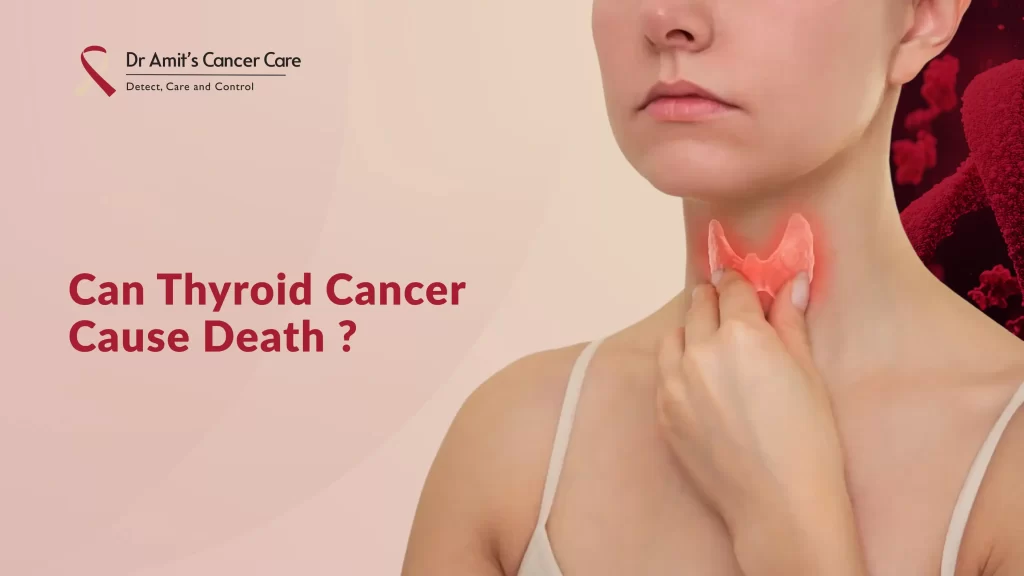

Type“can thyroid cancer cause death” into Google and you can almost hear the fear tapping the keyboard. A lump appears. A report lands. Suddenly the mind jumps straight to the worst ending. Is this how it ends? Does thyroid cancer lead to death?
Here is the truth most people don’t hear early enough. Thyroid cancer is not one road with one destination. It is more like a crossroads. Some paths move slowly and safely. Others demand urgency. This piece explains where real danger lies, where it usually doesn’t, and what actually decides the outcome.
Is Thyroid Cancer Commonly Fatal?
Short answer? No. But let’s slow down for a moment.
When people ask, “Does thyroid cancer lead to death?” They are usually picturing cancer as a loaded gun. In reality, thyroid cancer behaves more like a guarded crossroads. Most people pass through safely. A few face danger.
Most thyroid cancers do not cause death. Survival rates sit among the highest in oncology. Why? Because many tumors grow slowly, announce themselves early, and respond well to treatment.
So yes, thyroid cancer can cause death but only in specific situations. The risk depends on the type, the stage, and how soon treatment begins. Strip away the myth, and what’s left is clarity, not fear.
What Determines Fatality of Thyroid Cancer?
What decides whether thyroid cancer stays a chapter in your life or tries to write the ending? The answer isn’t mysterious, but it is layered.
Thyroid cancer and death risk does not hinge on a single factor. It turns on a few critical levers, each quietly shaping the outcome.
Key factors that influence death risk include:
1. Type of thyroid cancer
Some forms move slowly whereas others behave aggressively and are hard to contain.
2. Stage at diagnosis
A small, localised tumour is easier to control. Once cancer spreads beyond the thyroid, the risk rises sharply.
3. Age and overall health
A resilient body tolerates surgery and treatment better. Frailty narrows the margin for recovery.
4. Speed of tumour growth
Slow-growing cancers allow time for planning. Rapid growth leaves little room for delay.
5. Access to specialised treatment and follow-up
Experienced teams, timely intervention, and regular surveillance often make the decisive difference.
These factors set the framework for why some thyroid cancers are rarely fatal and why a few carry real danger.
Papillary Thyroid Cancer and What Doctors Mean by “Low Risk”
Papillary thyroid cancer is the most common form of thyroid cancer. It also happens to be one of the slowest. Think of it less like a wildfire and more like a candle that burns quietly, often for years, before anyone notices.
That is why so many people ask, how long can you live with papillary thyroid cancer? For most patients, the answer is reassuring. With proper treatment, life expectancy is often normal.
Death from papillary thyroid cancer is rare. Very rare. With timely surgery and proper follow-up, survival rates remain among the highest in all of cancer care. Many patients outlive the diagnosis by decades and eventually stop thinking about it altogether.
So when does risk rise? Usually only in specific situations. When the disease reaches an advanced stage. When it spreads to distant organs like the lungs or bones. Or when treatment is delayed for a long time and follow-up falls through the cracks.
Handled early, papillary thyroid cancer behaves less like a threat and more like a long-term condition that quietly steps aside once treated.
Anaplastic Thyroid Cancer and the Reality of Rapid Progression
Anaplastic thyroid cancer is rare. And it plays by different rules.
Why does this form raise such serious concern? Because it moves fast like a fire in dry grass leaving little room for delay.
Unlike slower thyroid cancers, this one does not wait politely. It grows suddenly. One day the neck feels tight. Soon, breathing feels like pulling air through a narrow straw.
This is often how anaplastic thyroid cancer kills you. Not quietly. But by rapid airway compression, squeezing the windpipe before the body can adapt.
Then it pushes further. Vital neck structures, blood vessels, nerves, the voice box become crowded. The tumor does not respect boundaries. And as the body struggles, systemic failure can follow. Organs tire. Strength fades.
Does this mean death from anaplastic thyroid cancer is inevitable? No. But time matters. Speed matters. Outcomes depend on how quickly the diagnosis is made and how tightly care is coordinated surgery, oncology, airway support, all moving together. This cancer demands urgency. Not panic. Urgency.
What Are the Other Types of Thyroid Cancer and Their Mortality Risk?
These thyroid cancers are quieter players in the story.
1. Follicular thyroid cancer
It often behaves like a slow-moving river, usually manageable, but risky if it slips into blood vessels and travels.
2. Medullary thyroid cancer
It is rarer and more stubborn. Driven by genetics and less by chance.
Which one carries more danger? It depends on timing. Caught early, both respond far better. Delay care, and the risk rises like ignoring a leak until the floor gives way.
What Patients in India Should Know About Thyroid Cancer Outcomes
When people search forthyroid cancer deaths in India, they are often asking a harder question: Is this likely to happen to me?
The honest answer is reassuring. Mortality from thyroid cancer stays low compared to many other cancers. When deaths do occur, they usually follow a familiar pattern. Diagnosis comes late. The cancer turns aggressive. Or care happens far from specialised centres.
Think of it like spotting a leak early versus discovering it after the house floods. Timely evaluation, expert treatment, and steady follow-up keep most patients safely on dry ground.
Does Thyroid Cancer Always Shorten Life Expectancy?
Here is the quiet truth most people don’t hear early enough. Living with thyroid cancer is not the same as dying from it.
Many patients go on to live for decades after treatment. Full careers. Long marriages. Loud family dinners. Cancer exit. Life stays.
Lifelong hormone replacement often sounds ominous, but it works more like wearing glasses than carrying a burden. It supports the body. It doesn’t shorten the clock.
Regular surveillance, simple, scheduled, boring by design acts like a lighthouse. It doesn’t stop at the sea. It helps you sail safely through it.
When Should Thyroid Cancer Patients Be More Concerned?
Most days after treatment feel ordinary. And that’s a good sign.
But what if something changes?
Rapid neck swelling that seems to appear overnight. Trouble breathing or swallowing, like a tight collar you can’t loosen. A voice that turns hoarse and refuses to return. Or a report that mentions an aggressive subtype. These are not reasons to panic. They are reasons to act. Early attention keeps small problems from turning serious.
What Happens to Life Span After Thyroid Cancer Treatment
So, can thyroid cancer cause death? Yes sometimes. But not usually.
For most people, thyroid cancer behaves less like a ticking clock and more like a chapter that closes.
The outcome depends on the type, the timing, and the care, not the diagnosis alone. Early detection changes the story. Specialist treatment changes the ending. Follow-up keeps the plot steady. Fear thrives on uncertainty. Clarity takes its power away. And for the vast majority of patients, life doesn’t shrink after thyroid cancer. It stretches on. Quietly. Reliably.
Meet Dr. Amit Chakraborty
Head & Neck Cancer Specialist
If something about your head and neck doesn’t feel right, you don’t need panic.
You need clarity.
Dr. Amit Chakraborty has spent nearly two decades doing exactly that, helping patients move from uncertainty to answers, and from diagnosis to recovery, with care that’s as precise as it is compassionate.
He is trained across India’s leading cancer institutes and the UK.
He is nationally and internationally recognised for complex head-and-neck cancer surgery.
And yes, he is one of the few specialists performing minimally invasive and robotic surgeries that protect what matters most: your voice, swallowing, and quality of life.
He treats every cancer type with experience, teamwork, and calm confidence. If your symptoms have been lingering for weeks and you are still “waiting it out,” an early consultation will give you peace of mind. Reach Out At DR Amit’s Cancer Care TODAY
Help Spread Awareness
Cancer isn’t always the final chapter. And with thyroid cancer, it very often isn’t.
When diagnosis happens early and treatment is right, the story can change dramatically.
What usually fuels fear isn’t the disease itself. But the fog around it. Unanswered questions. Confusing advice. Too much noise. Clarity cuts through that fog.
If this blog helped you understand things better even a little, pass it on. Share it with survivors, caregivers, or anyone quietly searching for answers. Because no one should feel lost when uncertainty comes knocking. And no one should have to figure this out alone.
Still got questions bouncing around in your head? That’s normal. They deserve clear answers. And yes we have them.
Don’t let doubt sit there doing push-ups in your mind. Help is closer than you think. One message. One call. That’s it. Drop us a message or ring us at +91-86577-17988. We are right here.


 Aug 20, 2024