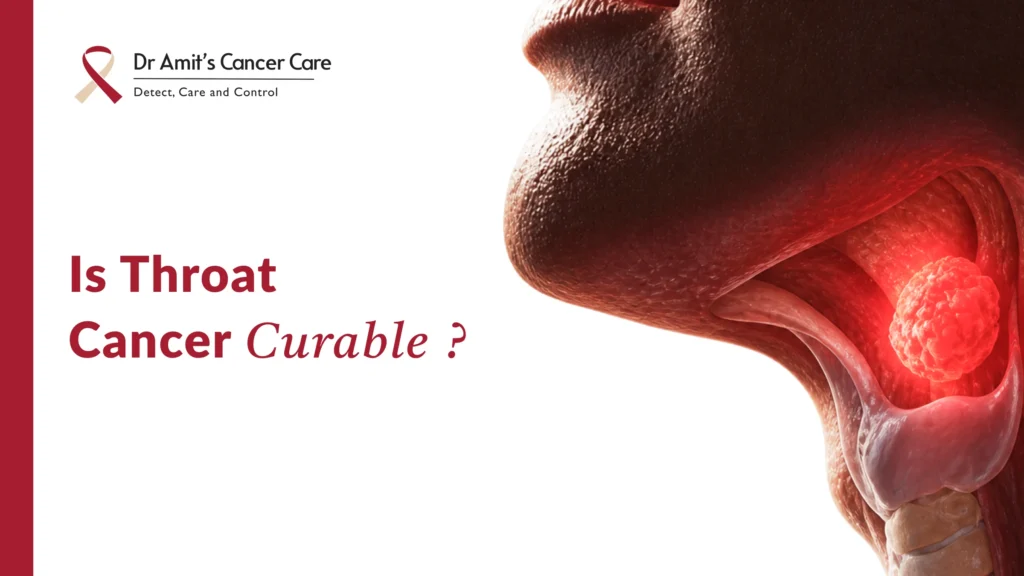

A throat cancer diagnosis can feel overwhelming. The first question most people ask is not about treatment or timelines. It is simply: can this be cured?
The answer is yes, in many cases. But the fuller answer depends on the stage, the type, and how quickly it is caught. Here is a clear breakdown of everything you need to know.
What Is Throat Cancer?
Throat cancer is not one single disease. It’s an umbrella term for the different types of cancers arising in the neck region, which include:
- Oropharyngeal cancer – affects the middle part of the throat, including the tonsils and base of the tongue. This is the most common type.
- Laryngeal cancer – affects the voice box.
- Hypopharyngeal cancer – affects the lower part of the throat above the food pipe.
- Nasopharyngeal cancer – affects the upper part of the throat behind the nose.
Each type behaves differently, responds to treatment differently, and carries its own survival figures. This is why a blanket yes or no on curability does not tell the whole story.
Is Throat Cancer Curable?
Yes, throat cancer can be cured, particularly when detected early. Most throat cancers are treatable at all stages, and a significant number are curable at stages one and two.
What factors curability :
- The stage
- The location where the cancer arises
- HPV related or not
- Overall health status and age of the patient
- How well the cancer responds to treatment
Survival Rates by Stage: What the Numbers Say
Survival rates give a statistical picture, not a personal verdict. They show how many patients with that specific cancer type and stage are alive five years after diagnosis.
Stage 1 Throat Cancer Five-year survival rates sit between 70% and 90%. At this stage, the cancer is localised, and treatment is more straightforward. The body responds well, usually.
Stage 2 Throat Cancer Survival rates range from 60% to 75%. The cancer is definitely more advanced at this stage, but still highly treatable. For treatment, surgery, radiation, or a combination of both are used.
Stage 3 Throat Cancer. By now, the cancer may have spread to the lymph nodes. Treatment often involves a combination of radiation and chemotherapy. Survival rates are lower than in the previous two stages, but the cancer is still curable.
Stage 4 Throat Cancer. This is the most advanced stage, where the cancer may have spread to other parts of the body. Cure is less common, but it is not impossible, particularly in cases where the spread is limited. Treatment at this stage focuses on controlling the disease, managing symptoms, and maintaining quality of life alongside life expectancy.
The HPV Factor: Why It Changes Everything
One of the biggest shifts in throat cancer outcomes over the past two decades is the rise of HPV-related cases.
About 70% of oropharyngeal cancers are now linked to HPV, specifically HPV-16. Patients with HPV-positive throat cancer do significantly better than those whose cancers are linked to smoking or alcohol.
HPV-positive patients have a three-year overall survival rate higher than that of HPV-negative patients. Local recurrence rates are also much lower for HPV-negative cases.
Is Throat Cancer Curable in India?
Yes. Cancer care and treatment in India have advanced significantly. Throat cancer is treated across major oncology centres like Dr Amit’s Cancer Care, with surgery, radiation, chemotherapy, targeted therapy, and immunotherapy.
The HPV vaccine is now available in India and plays a role in the prevention of HPV-associated throat cancers. Immunotherapy using drugs like nivolumab has also shown promising results in advanced head and neck cancers in Indian patients.
The challenge in India, as in many countries, is late presentation. Many patients arrive at a hospital in stage 3 or stage 4 because their symptoms were mistaken for a sore throat or allergies. Awareness and early consultation are the most important tools for improving outcomes.
Signs You Should Not Ignore
Throat cancer often mimics common conditions in its early stages. If any of the following persist for more than two weeks, it’s advisable to get medical attention:
- A sore throat that does not heal
- Hoarseness or a change in voice
- Difficulty or pain while swallowing
- A lump in the neck or throat
- Ear pain without an obvious cause
- Unexplained weight loss
- Persistent cough or coughing up blood
Early detection is the single biggest factor in whether throat cancer is curable.
How Is Throat Cancer Treated?
Treatment depends on the type, stage, and location of the cancer. Standard options include:
- Surgery – to remove the tumour, sometimes including lymph nodes
- Radiation therapy – often used alone for early-stage cancers or combined with chemotherapy for advanced cases
- Chemotherapy – used alongside radiation or to treat cancer that has spread
- Targeted therapy – drugs that attack specific proteins on cancer cells
- Immunotherapy – helps the immune system recognise and fight cancer cells
For early-stage laryngeal cancer, surgery or radiation alone can be equally effective. For advanced cases, a combination of two or three approaches is standard.
Final Thoughts, How Can Dr Amit Help?
Throat cancer is serious. But curable is a word that genuinely belongs in this conversation, especially when the disease is found early.
Stage and type matter. HPV status matters. Access to the right treatment matters. But above everything else, timing matters most.
If something in your throat has been bothering you for more than two weeks and is not getting better, that is your signal to see a doctor. The window for the best outcomes does not stay open indefinitely, and catching this early is the most powerful tool available. Book a Consultation with us at Dr Amit’s Cancer Care.
References:
- Deepti, Prinima Gupta, Goldie Gabrani, Nishtha Phutela, Unveiling the Factors Improving Prognosis in Head and Neck Cancer, 2025, available at, https://link.springer.com/article/10.1007/s12070-025-05762-4



 Jun 12, 2025