
Quick Answer: Chemotherapy can be given at any stage of cancer, but its purpose changes by stage:
Stage 0–I: Usually not needed; surgery alone often suffices
Stage II: May be given before surgery (neoadjuvant) or after (adjuvant)
Stage III: Often combined with surgery and/or radiation
Stage IV: Used in most cases to control growth and manage symptoms (palliative)
The exact approach depends on cancer type and pathology findings and not the stage alone.
Chemotherapy can be used at almost any stage of cancer, but the reason it’s given changes completely depending on the stage. It can be given before surgery to shrink a tumour, after surgery to reduce the chance of cancer, alongside radiation for locally advanced disease, or to control symptoms and slow the disease once it has spread. There is no single “chemo stage”. The timing and goal are decided by the stages of cancer treatment, type, and how it’s likely to behave.
This guide walks through how cancer staging works, the different points in treatment where chemotherapy may be used, including neoadjuvant, adjuvant, concurrent with radiation, and palliative, and the tests doctors rely on to decide which approach fits your specific cancer and what next steps you should take if you are advised cancer chemotherapy.
At What Stage of Cancer Is Chemotherapy Used
Chemotherapy can be used at almost any stage of cancer, from stage I through stage IV, but the possibility of the advising of the chemo treatment depends upon how advanced the cancer stage is. Stage 0 and early-stage I cancers are often treated with surgery alone, while chemotherapy becomes a much more central part of the plan from stage II onwards and is used in the large majority of stage IV cases.
Cancer Stage and Chemotherapy
A cancer’s stage describes how large the tumour is and how far it has spread, and it is the single biggest factor doctors use to decide whether, when, and why chemotherapy belongs in the treatment plan.
The treatment options for head and neck surgery are planned on the basis of the stages of cancer. Most solid cancers are staged from 0 to IV using the TNM system, which looks at the size of the primary Tumour, whether nearby lymph Nodes are involved, and whether the cancer has Metastasised (spread) to distant organs.
Here’s how the stage of cancer and chemotherapy are linked.
| Cancer Stage | Description and Treatment | Chemotherapy Type |
| Stage 0 and I | The cancer is small and localised. Surgery alone is often enough, and chemotherapy is usually not needed unless the specific cancer type carries a higher underlying risk. | Adjuvant chemotherapy may be considered after surgery in selected high-risk cases. |
| Stage II | The tumour is larger, or there are early signs it may behave aggressively. Chemotherapy is considered more often here, either to shrink the tumour before surgery or to lower recurrence risk afterward, depending on the case. | Neoadjuvant chemotherapy may be given before surgery, or adjuvant chemotherapy may be given after surgery. |
| Stage III | The cancer has typically reached nearby lymph nodes or surrounding tissue. Chemotherapy is frequently part of the plan at this stage, often alongside surgery and radiation. | Neoadjuvant chemotherapy, adjuvant chemotherapy, or concurrent chemoradiation may be used depending on the cancer type and treatment plan. |
| Stage IV | The cancer has spread to distant organs. Chemotherapy is used in most cases here, though the goal shifts toward controlling the disease and managing symptoms rather than removing it entirely. | Palliative chemotherapy or systemic chemotherapy is commonly used to control cancer growth and manage symptoms. |
The role of chemotherapy depends on your cancer type, stage, and overall treatment plan. If you have been diagnosed with cancer, a specialist can help you understand whether chemotherapy is needed and when it may be given.
Types of Chemotherapy
Cancer stage and chemotherapy type describe two different aspects of treatment. The stage describes how advanced the cancer is, while the type of chemotherapy describes when it is given and what doctors are trying to achieve.
These categories describe the timing and purpose of chemotherapy. They should not be treated as separate cancer stages, and the same type of chemotherapy may be considered at different stages depending on the cancer and treatment plan.
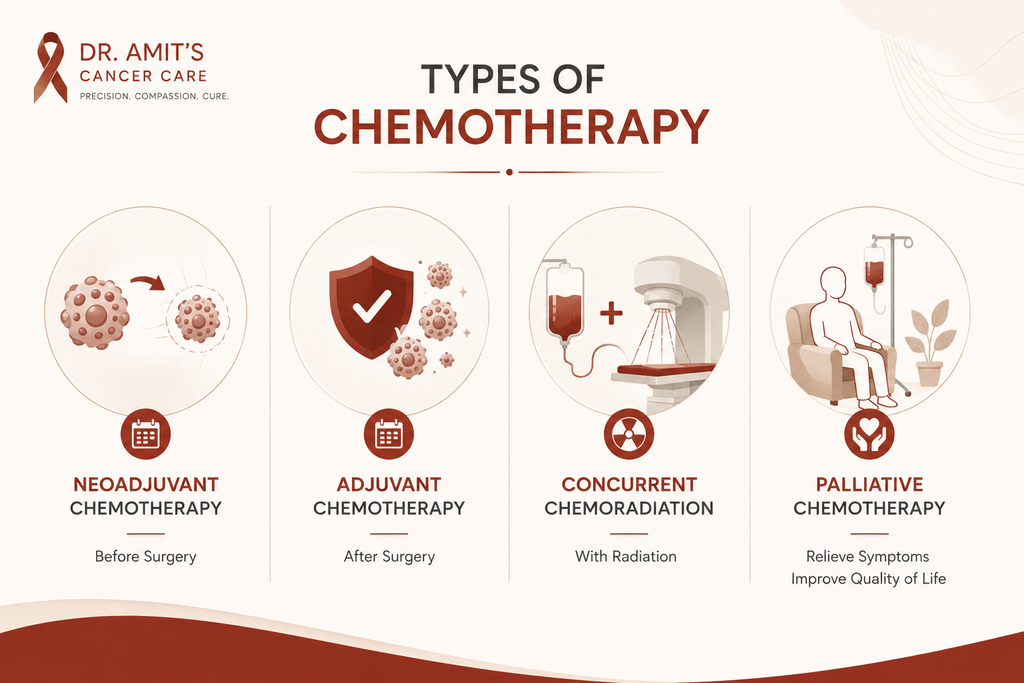
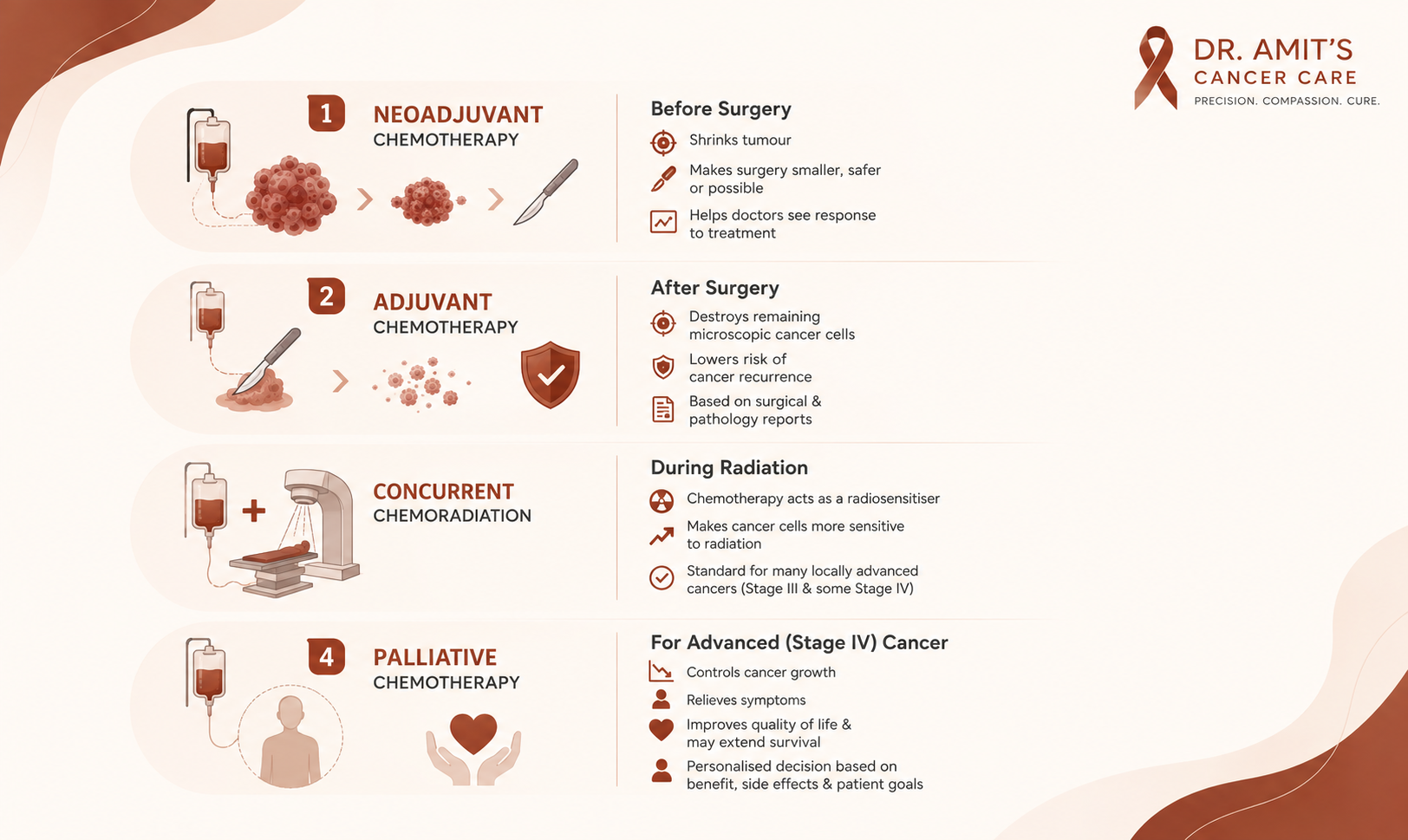
The cancer chemotherapy types are mainly based on when chemotherapy is given and what the treatment aims to achieve. Depending on the cancer type and stage, chemotherapy may be used before surgery, after surgery, with radiation, or to control advanced cancer.
Neoadjuvant chemotherapy
Given before surgery to shrink the tumour and make it easier to remove.
Adjuvant chemotherapy
Given after surgery to destroy remaining cancer cells and reduce the risk of recurrence.
Concurrent chemoradiation
Chemotherapy is given alongside radiation therapy to make cancer cells more sensitive to radiation and improve treatment effectiveness.
Palliative chemotherapy
Used mainly for advanced or metastatic cancer to slow cancer growth, relieve symptoms, and maintain quality of life.
When Is Cancer Chemotherapy Given Before Surgery ?
The chemotherapy given before the surgery, also known as neoadjuvant chemotherapy, is given to shrink a tumour enough to make the operation smaller and safer. It’s considered for larger stage II or III tumours, rather than very early or very advanced disease.
By reducing the size of a tumour before the cancer surgery, neoadjuvant chemotherapy helps turn an extensive operation into a more function-preserving one, and it also lets doctors see in real time how well the cancer responds to the drugs chosen.
Research for breast cancer found that giving chemotherapy before surgery increased the chances of breast-conserving surgery rather than a full mastectomy. (Fisher et al., 1998). For head and neck cancers, a similar principle applies. Advising chemotherapy before surgery helps the cancer operation be more conservative wherever the tumour’s size and location allow it.
Chemotherapy After Surgery in Cancer Treatment
The chemotherapy after surgery, also known as adjuvant chemotherapy, is given after surgery when the visible tumour is already removed his type of cancer chemotherapy’s job is to clean up cancer cells which are too small to see or test for, lowering the chance of the cancer coming back. This is usually considered once surgery confirms the cancer has reached lymph nodes or has other features that raise the risk of recurrence, which is usually at the stage III or stage IV cancer.
The decision to recommend adjuvant chemotherapy in many cancers, like oral, tongue and other head and neck cancer, is based on what the surgical and pathology reports show, not on how the patient feels afterwards, since many types, like micrometastatic disease, produce no symptoms at all.
“Patients often ask why they need more treatment when the surgery went well and they feel fine. But the decision is not based on symptoms but based on what we find in the pathology report. That’s the only way to know if there are microscopic cells left behind that can lead to cancer in future.”
— Dr. Amit Chakraborty
MBBS, MS – General Surgery,
MCh – Surgical Oncology MRCS (Royal College of London) UK
A study suggested that patients who have undergone surgery for stage II or stage III cancer and were advised adjuvant chemotherapy meaningfully improved both cancer-free survival and overall survival (André et al., 2009).
When Is Cancer Chemotherapy Combined With Radiation?
Chemotherapy is given at the same time as radiation rather than before or after surgery for many locally advanced cancers, particularly stage III and some stage IV head and neck cancers. This is also known as concurrent chemoradiation, and here the chemotherapy acts as a radiosensitiser, making the cancer cells easier to treat with radiation.
Research states that giving the two cancer treatments together produced a greater benefit than giving chemotherapy before radiation as a separate step (Pignon et al., 2009). This is a major reason concurrent chemoradiation has become a standard approach for locally advanced oral cancer, tongue cancer, laryngeal cancer, and hypopharyngeal cancer that can’t be fully addressed by surgery alone.
Palliative Chemotherapy for Stage IV Cancer
Palliative chemotherapy is used when cancer has spread to distant parts of the body, typically stage IV disease, and the goal shifts from eliminating the cancer to controlling its growth, pacifying symptoms, and increasing life span with a good quality of life.
Even without the goal of a cure, palliative chemotherapy can make a real, measurable difference to how a patient feels day to day. However, decisions around palliative chemotherapy are highly personalised and include calculating the expected benefit against side effects, overall fitness, and what matters most to the patient, which is why this conversation is usually done in a personalised clinic setting during a consultation.
Tests for Cancer Staging and Chemotherapy
Deciding at what stage chemotherapy should start relies on a combination of imaging, biopsy results, and the post-surgery pathology report. Imaging techniques such as a CT, MRI, or PET scan show the size of the tumour and whether it has reached lymph nodes or other organs. A biopsy confirms the exact type of cancer and how aggressive its cells look under the microscope, and the post-surgery pathology report gives the most accurate picture of margins, lymph node involvement, and microscopic spread.
Together, these findings are what an oncologist will need to decide whether chemotherapy is needed and at which cancer stage in the treatment sequence it is recommended.
Questions to Ask Your Oncologist About Chemotherapy
Before starting chemotherapy, a few direct questions can help you understand exactly why it’s being recommended, what it’s meant to achieve, and what your specific plan involves.
Following are the questions you may ask your oncologist before starting chemotherapy:
- What is the goal of my chemotherapy? Is it to shrink a tumour before surgery, to lower the risk of recurrence, or to control advanced disease?
- Why is chemotherapy being recommended at this stage, based on my scans and pathology report?
- How many cycles will I need, and how long does each one take?
- Will chemotherapy be given on its own, or alongside surgery or radiation, and in what order?
- What are the possible side effects, and how are they managed during treatment?
- Are there other treatment options I should know about it before starting chemotherapy?
An oncologist confident in your plan should be able to answer all of this clearly, tied to your specific cancer’s stage and pathology, not as a general explanation of chemotherapy.
At Dr. Amit Chakraborty’s consultation, you can go through these questions in the context of your own diagnosis, treatment goals, and overall health. With his experience across surgical, medical, and radiation oncology, he can help you understand exactly where chemotherapy fits into your treatment sequence and what to expect before you begin.
Book a Consultation with Dr Amit Chakraborty
The only reliable way to know whether, when, and why chemotherapy fits into your treatment is a proper evaluation of your specific cancer’s stage, type, and pathology, since the right sequence differs from one patient to the next. Reading about the general principles is a useful starting point, but it isn’t a substitute for that evaluation.
Dr Amit Chakraborty is a cancer surgeon with an MBBS, an MS in General Surgery, an MCh in Surgical Oncology, and an MRCS from the Royal College of Surgeons and works as part of a multidisciplinary tumour board that coordinates surgical, medical, and radiation oncology for each patient.
If you’ve been told you may need chemotherapy and would value a second opinion on the stage, sequence, or necessity of treatment, you can read more on our second opinion. Book a consultation with Dr Amit Chakraborty to understand exactly where chemotherapy fits into your treatment plan and contact us to schedule your visit.
If you have been advised chemotherapy or are unsure about the right treatment sequence, a specialist consultation can help you understand your diagnosis, treatment options, and the next steps.
References
Fisher, B., Bryant, J., Wolmark, N., Brown, A., Fisher, E.R., Wickerham, D.L., Begovic, M., DeCillis, A., Robidoux, A., Margolese, R.G., Cruz, A.B., Hoehn, J.L., Lees, A.W., Dimitrov, N.V. and Bear, H.D. (1998) ‘Effect of preoperative chemotherapy on the outcome of women with operable breast cancer‘, Journal of Clinical Oncology, 16(8), pp. 2672–2685.
André, T., Boni, C., Navarro, M., Tabernero, J., Hickish, T., Topham, C., Bonetti, A., Clingan, P., Bridgewater, J., Rivera, F. and de Gramont, A. (2009) ‘Improved overall survival with oxaliplatin, fluorouracil, and leucovorin as adjuvant treatment in stage II or III colon cancer in the MOSAIC trial‘, Journal of Clinical Oncology, 27(19), pp. 3109–3116.
Pignon, J.P., le Maître, A., Maillard, E. and Bourhis, J. (2009) ‘Meta-analysis of chemotherapy in head and neck cancer (MACH-NC): an update on 93 randomised trials and 17,346 patients’, Radiotherapy and Oncology, 92(1), pp. 4–14.
Geels, P., Eisenhauer, E., Bezjak, A., Zee, B. and Day, A. (2000) ‘Palliative effect of chemotherapy: objective tumor response is associated with symptom improvement in patients with metastatic breast cancer’, Journal of Clinical Oncology, 18(12), pp. 2395–2405.



 Jul 04, 2026