
Key Takeaways
- After total laryngectomy you can’t talk in your old voice, but there are 3 ways to speak again, which are an electrolarynx, a voice prosthesis and oesophageal speech.
- Electrolarynx is a small battery device you hold on the neck and most people can start using it within days of the surgery.
- Voice prosthesis is a small valve fitted in the wall between the windpipe and food pipe, and it can give a more natural sounding voice than other methods for many people.
- Oesophageal speech needs no device at all but it takes months of practice and not everyone is able to learn it.
- A lot of patients end up using two of these, mostly a prosthesis for daily talking and an electrolarynx kept aside for the day the valve is changed.
- The prosthesis should be cleaned only like your doctor or speech therapist showed you, and taking it out or changing it is their job and not yours.
- If the prosthesis falls out, seek urgent hospital care. Difficulty breathing through the stoma is an emergency. If you cough when drinking, contact your speech therapist or doctor promptly to check for a leak.
For a lot of patients the scariest part of hearing the word laryngectomy is not the surgery, it is the thought that they will never be able to talk to their family again. Good thing is that this is not true. In one study of 167 patients, around 7 out of 10 had successful tracheoesophageal speech after two years (Moon et al., 2014), and many others talk well with an electrolarynx or oesophageal speech.
Still every person is different. What method suits you will depend on the kind of surgery you had, whether you had radiation, your hands, your hearing and also what feels comfortable to you. Some people like the voice prosthesis, some find the electrolarynx easier and a few learn oesophageal speech.
In this blog we will tell you why the voice changes after laryngectomy, how an electrolarynx device, a voice prosthesis and oesophageal speech work, how tracheoesophageal puncture is done, how to choose the right one and how Dr. Amit Chakraborty can help you.
Worried about how you will talk after laryngectomy?
Why Does Your Voice Change After Laryngectomy?
Your voice comes from the vocal cords which are inside your voice box (larynx), where the air coming up from the lungs makes the cords vibrate and then your mouth, tongue and lips turn that sound into words.
To understand it in easy terms, in total laryngectomy the cords go out along with the voice box and the windpipe is opened in the neck as the stoma. Now whatever air comes from the lungs goes out from the neck and it never reaches the mouth.
Your mouth, tongue and lips are all there and they can still make words, only the sound is missing. So all 3 methods are basically different ways of getting that sound back. In a partial laryngectomy some of the cords are still there, so the voice is mostly kept, though it can stay rough like a hoarseness of voice.
What Is an Electrolarynx (Artificial Larynx)?
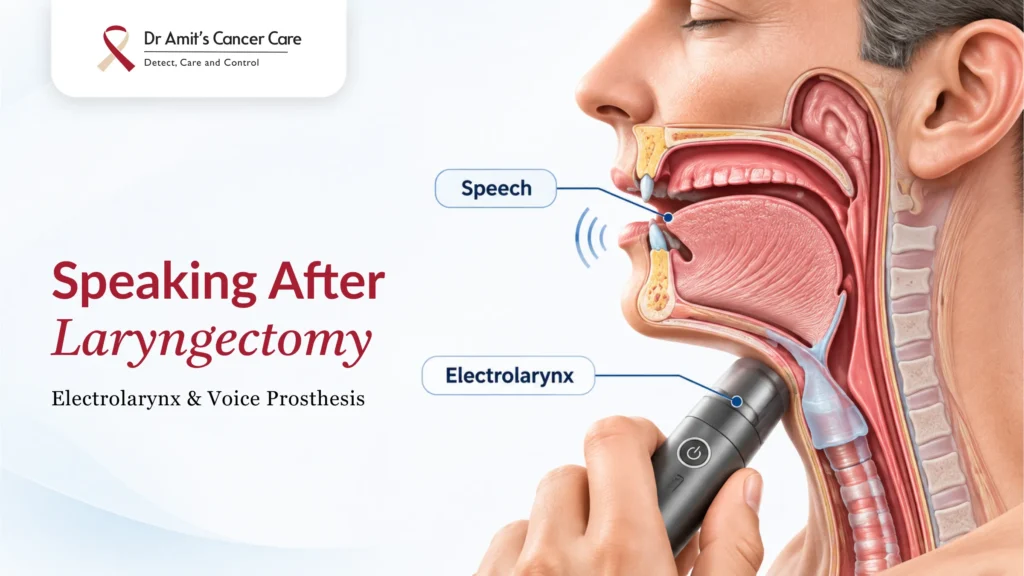
Electrolarynx is also called as artificial larynx and it is a small battery device, almost like a small torch. You keep it on your neck or below the chin, press the button and it starts making a buzz. That buzz goes inside your mouth and you just move your lips and tongue like you normally do to make the words. There is also a type with a small tube which you keep in the corner of your mouth, which is useful in the first few weeks when the neck is still swollen.
Following are some features of an electrolarynx:
- It can be used within days of surgery, even before the neck heals fully
- No surgery or valve is needed
- Easy to learn for most people
- Voice sounds robotic or mechanical
- You need one hand free to hold it
- Battery needs charging and the device is not cheap
Even the people who talk mainly with a prosthesis like to keep an electrolarynx device at home because on the days the valve is leaking or getting changed, at least they are not left without a voice.
| Expert Insight “Most of my patients start with an electrolarynx in the first week itself, so that they are never left without a voice. Later we decide on a voice prosthesis or other option depending on their healing and comfort. What I always tell families is that practice at home is as important as the device, so keep talking to them, give them time and don’t complete their sentences for them.” Dr. Amit Chakraborty MBBS, MS, MCh (Surgical Oncology), MRCS (UK) Head & Neck Cancer Specialist Registered Medical Practitioner | 2008113798 |
Voice Prosthesis and Tracheoesophageal Puncture
Voice prosthesis is basically a tiny silicone valve which opens only one side. First the surgeon makes a small hole between your windpipe and food pipe, this hole is called tracheoesophageal puncture or TEP, and then the valve is put inside it. Through it air goes from the windpipe to the food pipe. The valve is designed to stop swallowed food and water reaching the lungs, but it can sometimes leak and needs checking.
So to talk you take a breath and close the stoma with your thumb or with a special hands-free valve. The air from your lungs then goes through the prosthesis into the food pipe, the food pipe walls start vibrating and that sound reaches your mouth where you make words out of it. As it uses your own lung air, you can speak longer sentences and the voice is louder and more natural than the other two.
Your surgeon can make the puncture in the same laryngectomy surgery, which is primary TEP, or after a few weeks or months in a small separate surgery, which is secondary TEP. In the study of 167 patients, success rates were 76% after primary TEP and 68% after secondary TEP, but the authors did not find a clear difference between the two approaches (Moon et al., 2014).
There is also a systematic review where listeners found voice prosthesis speech the most pleasant and easiest to understand, more than oesophageal speech and electrolarynx. But most studies in it were small ones and the authors themselves said the evidence is still weak (van Sluis et al., 2018).
The valve does not last forever. It usually needs to be changed every few months in the OPD and it is a quick procedure without any cut. In an Indian study on 58 patients whose prostheses had failed, the most common problem was leakage around or through the valve and a fungus called Candida was found on most of them (Chaturvedi et al., 2014).
Oesophageal Speech
In oesophageal speech you don’t need any device or valve. You learn to take a small gulp of air into your food pipe and then let it come back up slowly, kind of like a controlled burp. As it comes up it vibrates the top of the food pipe and that sound is used for talking.
Its biggest plus is that your hands are free and there is nothing to buy or change. But it takes many months of practice with a speech therapist, the sentences are short because you can only take in a little air at a time and many people find it very hard to learn. This is why it is used less today, but some people do learn it really well.
Which Speaking Method Is Right for You?
Below table compares all three methods:
| Point | Electrolarynx | Voice prosthesis | Oesophageal speech |
| When you can start | Within days of surgery | After the puncture heals, usually 1 to 2 weeks | After healing, then months of practice |
| How natural it sounds | Robotic | Most natural | Low and soft |
| Surgery needed | No | Yes, small puncture | No |
| Hands | One hand to hold it | Thumb on stoma or hands-free valve | Hands free |
| Upkeep | Charging batteries | Valve change every few months, daily cleaning | Nothing |
| Main problem | Mechanical sound | Leakage, fungus | Hard to learn |
Honestly which one is best for you depends on you only. If you can’t clean it every day, your eyesight is weak, hands shake or the tissues are fragile after radiation, a voice prosthesis may not suit you. People who want something easy and fast usually pick the electrolarynx. And it is completely fine if you start with one and then shift to the other later, your speech therapist will make you try both.
Starting Speech Therapy
Your speech therapist is the one who will teach you this new voice and it is good if you can meet them before the surgery itself. In the first few sittings they will see what method works for you, show you the exact spot on the neck for the electrolarynx and make you practise speaking slowly and clearly. After the puncture heals they fit or check the prosthesis and tell you how to close the stoma and how much air to push. In the start the voice may not be clear and that is okay, it gets much better with practice in the first few months.
How to Take Care of Your Voice Prosthesis
Following are a few things which help your prosthesis last longer and work well:
| Clean the inside of the prosthesis daily with the small brush and flush given to you, the way your speech therapist taught youKeep the stoma area clean and use a stoma filter (HME)Rinse your mouth after meals and brush your teeth twice a day, as fungus grows more in a dirty mouthAsk your doctor about an anti-fungal medicine if your prosthesis keeps failing earlyKeep a watch while drinking water, because coughing every time can mean that the valve has started leakingHave a spare electrolarynx at home so that you can still talk when the prosthesis is giving trouble |
The Role of Family in Learning to Speak Again
Learning to talk in a new way is not easy at all and in the first few weeks your loved one may get irritated, may feel shy to talk in front of others or may just feel low, and this is where the family support makes the biggest difference. Sit with them while they are practising and if you don’t get what they said, simply ask them to say it once more instead of guessing. Keep a notepad or phone near them for the times when talking feels tough. It also helps if they join a laryngectomy support group, since meeting people who are already talking well with these methods gives them a lot of hope and it is an important part of head and neck cancer survivorship.
When to See Your Doctor
| When to Get Medical Advice You should meet your doctor or speech therapist when drinking water makes you cough, food is coming out from the stoma, the voice has suddenly become weak or stopped or the prosthesis does not seem to be in its place, and also when there is redness, swelling or bleeding near the stoma or the puncture. If the prosthesis comes out completely, seek urgent care as the opening can close quickly. Use a supplied catheter or dilator only if your specialist team has trained you to insert it, and never force it in. Not being able to breathe properly from the stoma is an emergency and you should go to the hospital emergency at once. |
Dr. Amit Chakraborty, Head & Neck Cancer Specialist (MBBS, MS, MCh Surgical Oncology, Registered Medical Practitioner: 2008113798), says that talking about speech should start even before the laryngectomy, because when the patient and family already know what options they will have, they don’t feel lost after the surgery. If you or someone in your family is going for a laryngectomy for laryngeal cancer or is finding it hard to talk after one, you can book a consultation or take a second opinion.
Planning a laryngectomy and want to know your speech options?
This article is for general health education and is not a substitute for personal medical advice. Please speak to your doctor and speech therapist about your own speech plan.
References
- Moon, S., Raffa, F., Ojo, R., Landera, M.A., Weed, D.T., Sargi, Z. and Lundy, D. (2014). Changing trends of speech outcomes after total laryngectomy in the 21st century: a single-center study. The Laryngoscope, 124(11), 2508–2512.
- Chaturvedi, P., Syed, S., Pawar, P.V., Kelkar, R., Biswas, S., Datta, S., Nair, D., Chaukar, D. and D’Cruz, A.K. (2014). Microbial colonization of Provox voice prosthesis in the Indian scenario. Indian Journal of Cancer, 51(2), 184–188.
- van Sluis, K.E., van der Molen, L., van Son, R.J.J.H., Hilgers, F.J.M., Bhairosing, P.A. and van den Brekel, M.W.M. (2018). Objective and subjective voice outcomes after total laryngectomy: a systematic review. European Archives of Oto-Rhino-Laryngology, 275(1), 11-26.



 Nov 15, 2024