
Key Takeaways
- Neck dissection is an operation that removes lymph nodes from the neck. It is used mainly for head and neck cancers that have spread, or may spread, to the lymph nodes.
- There are several types. They differ in how many lymph node areas are removed and which nearby structures are kept. The main types are radical, modified radical, selective and extended.
- Lymph nodes in the neck are grouped into levels. Doctors number these levels from I to VII. The levels removed depend on where the cancer began.
- The surgeon tries to remove as little as is safe. Radical neck dissection is used less often today. Modified and selective types are chosen when the cancer allows it.
- Recovery takes weeks. Most people stay in hospital for a few days. Neck and shoulder exercises are an important part of getting back to normal.
- Side effects are possible but many can be managed. They include neck numbness, stiffness and shoulder weakness. Your surgeon will explain the risks that apply to your operation.
Neck dissection is a surgery to remove lymph nodes and the tissue around them from one or both sides of the neck. Surgeons use it to treat or check for head and neck cancer that has spread from the mouth, throat, voice box, thyroid or skin of the head and neck. The type of neck dissection depends on the cancer site, the stage and which lymph node levels are at risk.
The word dissection can sound alarming, and the operation is a big one. It helps to know what is removed, why and how people recover. This guide explains the levels of the neck, the types of neck dissection, how the surgery is done, what recovery looks like and which side effects to expect.
Have a question about neck dissection surgery?
What Is Neck Dissection Surgery?
During a neck dissection, the surgeon removes lymph nodes from selected areas of the neck so they can be tested for cancer.
In a neck dissection, the surgeon removes the lymph nodes in selected areas of the neck. The neck has hundreds of small lymph nodes. These are part of the body’s immune system. They also act as filters. Cancer cells that leave a tumour often travel through lymph channels and get caught in these nodes first.
After the surgery, the nodes are sent to the pathology lab. The report shows whether cancer cells are present, how many nodes are involved and whether the cancer has grown outside the node. This information helps decide whether further treatment such as radiotherapy is needed.
Why Is Neck Dissection Done?
Neck dissection is done to remove cancer that has spread to the lymph nodes in the neck. It is also done as a precaution when the cancer is likely to have spread there but cannot yet be seen or felt. This lowers the chance of the cancer growing in the neck later and shows the surgeon how far the disease has reached.
There are two main reasons.
The first is when cancer has already spread to the neck nodes. Removing them is part of treatment. This is called a therapeutic neck dissection.
The second is when the nodes feel normal but the chance of hidden spread is high. This is common in oral cancer. The surgeon removes the nodes at risk as a precaution. This is called an elective neck dissection. A large trial of people with early oral cancer found that elective neck dissection gave better survival than waiting and operating only if nodes appeared later (D’Cruz et al., 2015).
Not everyone with cancer needs a neck dissection. The decision depends on the site and size of the tumour, scans and your overall health.
Neck Dissection Levels
Surgeons divide the lymph nodes of the neck into levels. The numbering helps them describe exactly which areas are removed (Robbins et al., 2008).
| Level | Where it is |
| Level I | Under the chin and under the jaw (IA and IB) |
| Level II | Upper part of the neck along the large jugular vein, near the angle of the jaw IIA lies in front of the spinal accessory nerve and IIB lies behind it |
| Level III | Middle part of the neck along the jugular vein |
| Level IV | Lower part of the neck, just above the collarbone |
| Level V | Back of the neck, behind the large neck muscle VA is the upper part and VB is the lower part, divided at the level of the cricoid cartilage |
| Level VI | Front of the neck, around the voice box and thyroid |
| Level VII | Upper chest, behind the breastbone |
Cancers in different places spread to different levels first. Oral cancers most often spread to levels I, II and III. Thyroid cancers more often involve level VI.
| Note Levels are a map used by surgeons. You do not need to memorise them. It is enough to know that the surgeon chooses the levels based on where your cancer started. |
Types of Neck Dissection
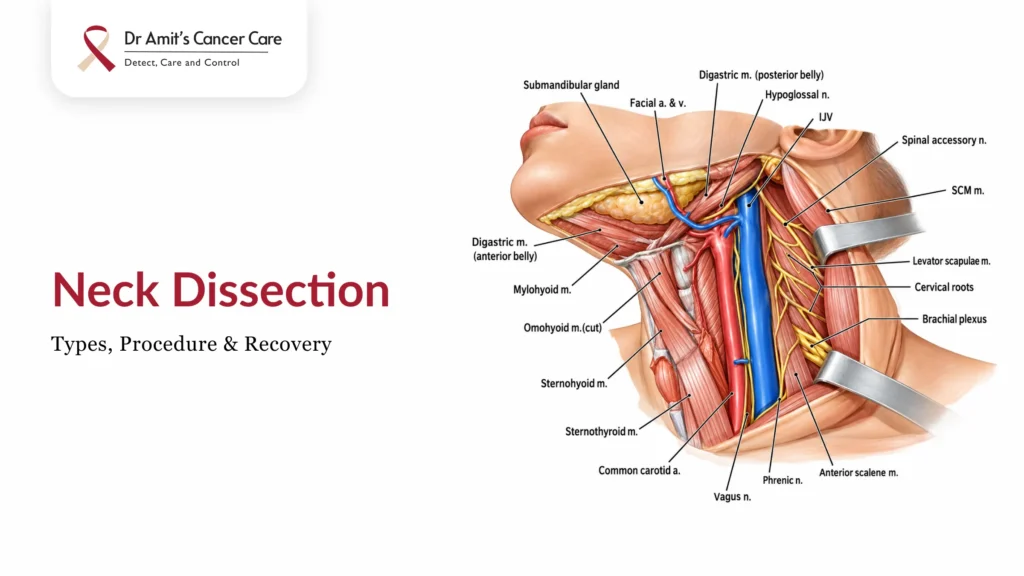
The neck dissection types are named by what is removed and what is left in place. Three structures are important. The large neck muscle called the sternocleidomastoid, the internal jugular vein and the spinal accessory nerve, which controls shoulder movement (Robbins et al., 2002).
| Type | Levels removed | What is kept |
| Radical neck dissection (RND) | I to V | None of the three structures. All are removed. |
| Modified radical neck dissection (MRND) | I to V | One or more of the muscle, vein and nerve. |
| Selective neck dissection (SND) | Some levels only | All three structures. |
| Extended radical neck dissection | I to V plus extra | Depends on what is removed beyond the standard. |
Radical neck dissection
This is the most extensive type. The surgeon removes the lymph nodes at levels I to V along with the muscle, the vein and the spinal accessory nerve. It is used when cancer has spread widely in the neck or has grown into these structures. Because the nerve is removed, shoulder weakness is likely. This is why surgeons now use it only when it is truly needed.
Modified radical neck dissection
Here the same lymph node levels I to V are removed. The difference is that the surgeon saves one or more of the muscle, the vein and the nerve. In type I the nerve is kept. In type II the nerve and the muscle are kept. In type III all three are kept. Saving the nerve helps protect shoulder movement. This type is chosen when the nodes are involved but the cancer has not grown into these structures.
Selective neck dissection
In a selective neck dissection only the levels most likely to hold cancer are removed. The muscle, vein and nerve are all left in place. Because less tissue is removed, recovery is usually easier and shoulder problems are less common.
The supraomohyoid neck dissection is the best known type. It removes levels I, II and III. It is named after a small muscle in the neck, the omohyoid. It is often used for oral cancer when the neck nodes feel normal, since the first spread is usually to these levels. Other selective types include the lateral neck dissection, which removes levels II to IV, and the central neck dissection, which removes level VI.
Extended radical neck dissection
Sometimes extra nodes or structures need to be removed as well. These can include other lymph node groups, a nerve or a muscle. This is uncommon and is done only when the cancer has spread beyond the usual areas.
| Expert Insight “The goal is to remove all the cancer that can be removed while protecting as much function as possible. That is why the type of neck dissection is chosen carefully, based on the cancer and not on a fixed routine.” Dr. Amit Chakraborty MBBS, MS, MCh (Surgical Oncology), MRCS (UK) Head & Neck Cancer Specialist Registered Medical Practitioner | 2008113798 |
How Is Neck Dissection Surgery Done?
Neck dissection is done under general anaesthesia, so you are asleep during the operation. It is often performed together with surgery to remove the main tumour. The whole operation can take several hours.
The surgeon makes a cut in a natural skin crease of the neck. The skin is lifted to expose the lymph nodes and the fatty tissue around them. The affected lymph nodes are removed level by level. The surgeon works carefully around the nerves, the large blood vessels and the muscles. Nerves that control the shoulder, the lower lip and the tongue are identified and protected where possible.
When the dissection is complete, the surgeon places one or two thin tubes called drains under the skin. They collect fluid that builds up after surgery. The skin is then closed with stitches or staples.
Neck Dissection Recovery
Recovery depends on the type of operation and whether the main tumour was also removed. The time frames below are general. Your surgeon will tell you what applies to you.
| Stage | What to expect |
| First few days | You stay in hospital. You will have pain medicine and a drain in the neck. The nurses help you sit up and move early. |
| Drain removal | The drains come out when the amount of fluid falls to a small level. This is often within the first week. |
| First two to four weeks | Neck swelling, tightness and numbness are common. You can usually do light daily activities. Heavy lifting is avoided. |
| Weeks to months | Stiffness and numbness slowly improve. Exercises help the neck and shoulder regain movement. |
A physiotherapist usually teaches simple neck and shoulder exercises. They are started when the surgeon says it is safe. Studies in people treated for head and neck cancer suggest that regular exercise can reduce shoulder pain and stiffness after neck dissection (McNeely et al., 2008).
At home, keep the wound clean and dry as advised. Take your pain medicine as prescribed. Sleep with your head slightly raised if the swelling bothers you. Follow-up visits are important. The surgeon will check the wound and discuss the pathology report. If radiotherapy is advised, it usually starts after the wound has healed.
Neck Dissection Side Effects
Every operation has risks. Some neck dissection side effects are temporary. Others can last longer. The risks are generally lower with selective types than with radical ones.
| Side effect | Why it happens |
| Numbness of the neck skin and ear | Small sensory nerves in the neck are cut or stretched during surgery. |
| Neck stiffness and tightness | Scar tissue forms as the wound heals. |
| Shoulder pain and weakness | The spinal accessory nerve is bruised, stretched or removed. |
| Weakness of the lower lip | A small nerve that moves the corner of the mouth is affected. |
| Swelling in the face or neck | Lymph fluid drains less well after nodes are removed. |
| Fluid collection or bleeding | Fluid or blood can collect under the skin. |
| Infection or poor wound healing | This can happen after any surgery, especially after radiotherapy. |
| Chyle leak | A milky fluid leaks from a small duct in the lower neck. This is uncommon. |
Most of these problems are treated with simple measures. Physiotherapy helps shoulder and neck movement. Swelling can be eased with massage and skin care taught by a therapist. A chyle leak or a fluid collection may need extra treatment.
Permanent numbness over part of the neck or ear is common. It is usually not painful. Many people get used to it over time.
When to Get Medical Advice After Neck Dissection
Some discomfort after surgery is expected. A few signs need prompt attention.
| When to Get Medical Advice Contact your surgeon or hospital if you have fever, increasing redness or pus at the wound, sudden swelling of the neck, a milky fluid in the drain, trouble breathing or swallowing, or pain that is getting worse instead of better. |
Dr. Amit Chakraborty, Head & Neck Cancer Specialist (MBBS, MS, MCh Surgical Oncology, Registered Medical Practitioner, 2008113798), explains that these signs often mean fluid, infection or bleeding that is best dealt with early. Being aware of them helps patients and families seek help in time.
Questions You Can Ask Your Surgeon
Before surgery, it can help to write down your questions. You could ask which type of neck dissection is planned and why. It is also reasonable to ask which lymph node levels will be removed and which nerves will be protected. You could ask what the recovery will involve and how long the hospital stay is likely to be. It is fair to ask about the risks that apply to you and what support is available afterwards. If you are unsure about any recommendation, you can ask for a second opinion.
Are you looking for information about neck surgery for cancer?
This article is for general health education and is not a substitute for personal medical advice. Please speak to your treating doctor about your own diagnosis and treatment plan.
Frequently Asked Questions
What is neck dissection?
Neck dissection is a surgery to remove lymph nodes and surrounding tissue from the neck. It is mainly used for cancers of the head and neck that have spread or may spread to the lymph nodes.
What are the types of neck dissection?
The main types are radical, modified radical, selective and extended radical neck dissection. They differ in the number of lymph node levels removed and the structures that are kept.
What is radical neck dissection?
It removes the lymph nodes at levels I to V along with the large neck muscle, the internal jugular vein and the spinal accessory nerve. It is used when cancer has spread widely in the neck.
What is modified radical neck dissection?
It removes the same lymph node levels as a radical neck dissection but saves one or more of the muscle, the vein and the nerve. It is chosen when the cancer has not grown into these structures.
What is MRND surgery?
MRND means modified radical neck dissection. It removes lymph nodes from levels I to V but keeps one or more of the neck muscle, jugular vein and shoulder nerve.
What is selective neck dissection?
It removes only the lymph node levels that are most likely to hold cancer. The muscle, vein and nerve are left in place.
What is a supraomohyoid neck dissection?
It is a selective neck dissection that removes levels I, II and III. It is often used in oral cancer when the neck nodes feel normal.
What are the levels of neck dissection?
The neck lymph nodes are grouped into levels I to VII. Level I is under the chin and jaw. Levels II to IV run down the side of the neck. Level V is at the back, and level VI is at the front around the voice box and thyroid.
How long does neck dissection recovery take?
Most people stay in hospital for a few days. Daily activities often return over two to four weeks. Stiffness and numbness may take months to improve.
What are the side effects of neck dissection?
Common effects include neck numbness, stiffness and swelling. Shoulder weakness, lower lip weakness, infection and fluid collection can also occur. Your surgeon will tell you which risks apply to you.
Is neck dissection a major surgery?
Yes. It is done under general anaesthesia and can take several hours. Most people recover well with proper wound care and exercises.
Will I have a scar after neck dissection?
Yes. The cut is placed in a natural skin crease where possible. The scar usually fades over time.
References
D’Cruz, A.K. et al. (2015) ‘Elective versus therapeutic neck dissection in node-negative oral cancer’, New England Journal of Medicine, 373(6), pp. 521–529.
McNeely, M.L. et al. (2008) ‘Effects of exercise on upper extremity pain and dysfunction in head and neck cancer survivors: a randomized controlled trial’, Cancer, 113(1), pp. 214–222.
Robbins, K.T. et al. (2002) ‘Neck dissection classification update: revisions proposed by the American Head and Neck Society and the American Academy of Otolaryngology–Head and Neck Surgery’, Archives of Otolaryngology–Head & Neck Surgery, 128(7), pp. 751–758.
Robbins, K.T. et al. (2008) ‘Consensus statement on the classification and terminology of neck dissection’, Archives of Otolaryngology–Head & Neck Surgery, 134(5), pp. 536–538.


 Aug 20, 2024