When you are diagnosed with stage 1 tongue cancer, precision matters. Staging is not a loose label. It is defined by measurable criteria.
In clinical terms, first stage tongue cancer means:
- The tumour measures 2 centimetres or less in its greatest dimension.
- There is no clinical or radiological evidence of lymph node involvement in the neck.
- There is no distant metastasis to organs such as lungs or liver.
This is classified under the TNM system as:
- T1 – tumour 2 cm or smaller
- N0 – no regional lymph node spread
- M0 – no distant metastasis
Put together: T1 N0 M0. That is what defines 1st stage tongue cancer. Nothing more. Nothing less.
This is why imaging and proper evaluation are essential. A lesion may appear small on the surface but must be assessed for depth. Staging is not guesswork. It is based on examination, biopsy, and imaging.
Why Early Staging Matters
Early staging is not just a classification exercise. It changes what you face next.
With stage 1 tongue cancer:
- Cure rates are high when treated appropriately.
- Surgery is usually limited to the tumour site.
- Extensive reconstruction is often unnecessary.
- Additional treatments such as radiation are rarely required when margins are adequate.
This is where stage 1 tongue cancer survival rates differ significantly from advanced stages. When disease is confined and excised completely, long-term control is strong.
The early stage also protects function. Because the tumour is small:
- Less tissue removal is required.
- Tongue mobility can often be preserved.
- Speech and swallowing outcomes are generally favourable.
This is not about aggressive removal alone. It is about measured excision with clear margins while preserving structure. Understanding this gives you control. You are not facing widespread disease. You are addressing a defined, localised problem.
Next, you need to understand how this condition is first presented.
Early Signs and Symptoms and When to Seek Evaluation
Early-stage disease rarely announces itself dramatically. Stage 1 tongue cancer often begins as something subtle. A small change. A patch. A sore that lingers.
You may have dismissed it once. Then noticed it again. Look closely at what your body has been signalling.
a. Symptoms of Tongue Cancer
With first stage tongue cancer, symptoms are usually localised and mild. They may include:
- A persistent ulcer on the tongue that does not heal
- A non-healing sore lasting more than 2–3 weeks
- Mild pain or a burning sensation while eating spicy food
- A small lump or thickened area on the side of the tongue
- Occasional bleeding from the lesion
The key word is persistent. A routine mouth ulcer heals within two weeks. A malignant lesion does not follow that pattern. It remains. It may grow slowly. It may become firmer at the edges.
If you run your tongue along the lesion, you may notice:
- A slightly raised margin
- A rough surface
- A hardened base
These sensory changes matter.
b. Signs of Tongue Cancer Often Ignored
In 1st stage tongue cancer, symptoms may be understated. You may not have significant pain. You may continue eating normally.
Watch for:
- White patches (leukoplakia)
- Red patches (erythroplakia)
- Mild discomfort during speech
- Slight difficulty moving the tongue fully to one side
- Subtle stiffness
These changes are easy to ignore. They do not disrupt daily life immediately. That is precisely why early disease can be overlooked.
C. When to Seek Evaluation for Tongue Cancer
Seek evaluation if:
- A tongue lesion persists beyond 2–3 weeks
- The ulcer increases in size
- The surface becomes irregular or firm
- There is unexplained bleeding
- You have a history of tobacco or alcohol use
Early consultation does not mean advanced disease. It means timely clarification. When diagnosed at this stage, stage 1 tongue cancer treatment is usually simpler and outcomes are stronger. The survival rate for stage 1 tongue cancer reflects this advantage.
The next step is confirmation. Suspicion alone is not a diagnosis.
How Stage 1 Tongue Cancer is Diagnosed
Diagnosis moves from observation to confirmation. Do not rely on appearance alone. A small ulcer can look harmless. It may not be. Accurate staging defines your treatment plan. It also determines your prognosis and influences stage 1 tongue cancer survival rates.
a. Clinical Examination
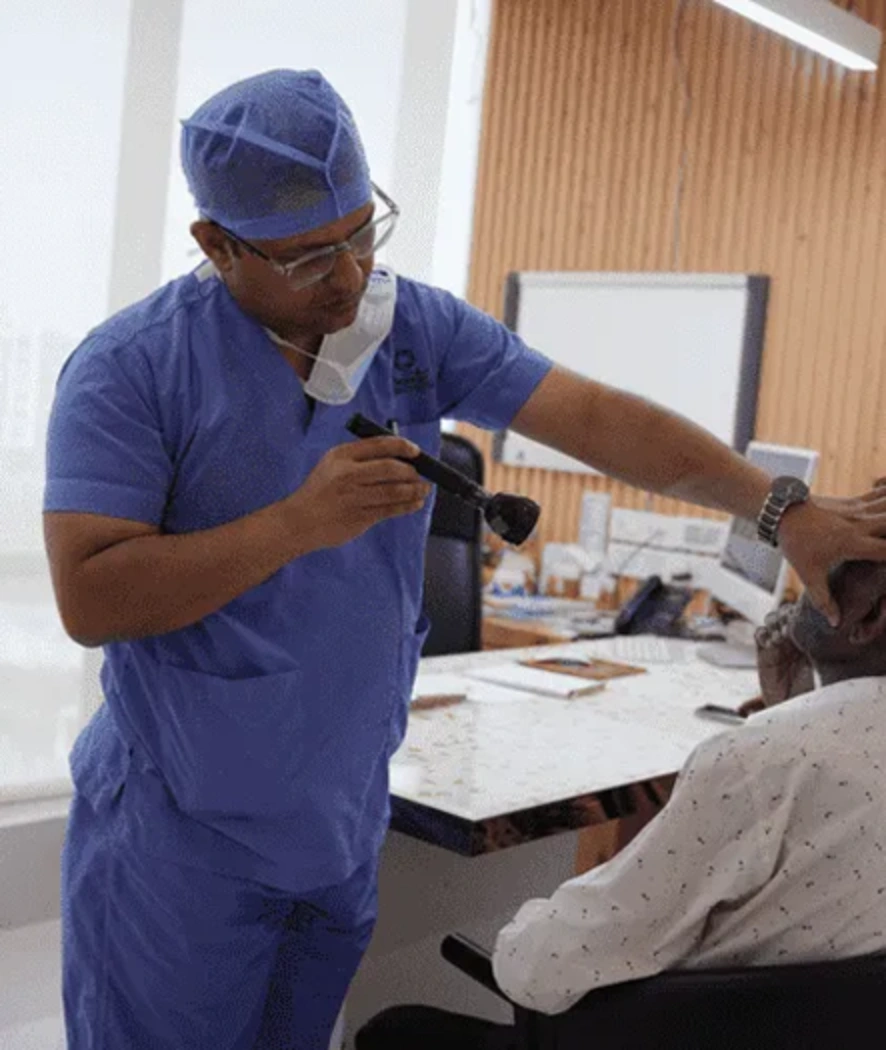
Your evaluation begins with a structured head and neck examination.
Expect your surgeon to:
- Inspect the tongue under proper lighting
- Palpate the lesion to assess firmness
- Measure approximate surface dimensions
- Assess tongue mobility
- Examine the floor of mouth
- Palpate the neck for lymph nodes
Mobility matters. A freely mobile tongue suggests limited infiltration. Restricted movement may indicate deeper involvement. Neck examination is essential even in first stage tongue cancer. Enlarged lymph nodes can change staging. Clinical examination gives direction. It does not give certainty.
b. Biopsy
A biopsy confirms the diagnosis. Nothing replaces it.
Here is what you need to understand:
- Suspicion is based on appearance.
- Diagnosis is based on histopathology.
A biopsy removes a small portion of the lesion under local anaesthesia. That sample is examined under a microscope to confirm:
- Presence of cancer cells
- Type of malignancy (usually squamous cell carcinoma)
- Tumour differentiation
Without biopsy, you do not have confirmed stage 1 tongue cancer. You have a possibility. Biopsy converts possibility into fact.
c. Imaging
Once cancer is confirmed, imaging defines the stage.
For 1st stage tongue cancer, imaging serves two purposes:
- Measure depth of invasion
- Evaluate cervical lymph nodes
MRI is commonly used because it defines soft tissue planes clearly. CT scan may be used when bone involvement is suspected.
Imaging helps confirm:
- Tumour size ≤ 2 cm
- No nodal enlargement
- No deeper extension
Only after biopsy and imaging can you accurately label the condition as stage 1 tongue cancer (T1 N0 M0).
Accurate staging protects you from undertreatment and overtreatment.
Now that diagnosis is clear, the next step is management.
Treatment of Stage 1 Tongue Cancer
When you are diagnosed with stage 1 tongue cancer, treatment is usually direct. Clear. Surgical.
Because the tumour is small and localised, surgery forms the foundation of stage 1 tongue cancer treatment.
a. Surgery as Primary Treatment
The standard procedure is wide local excision.
This means:
- Removing the tumour
- Removing a rim of healthy surrounding tissue
- Preserving as much normal tongue as safely possible
Do not focus only on visible tumors. Cancer extends microscopically beyond what you see. That is why margin planning is central. The goal is simple in principle: Remove the entire tumour with adequate healthy tissue around it.
This approach provides:
- High local control
- Strong stage 1 tongue cancer survival rates
- Reduced need for additional therapies
In most early-stage cases, surgery alone is sufficient.
b. What “Clear Margins” Means
Margins are examined under a microscope after surgery. You will see this mentioned in your pathology report.
- Clear margins mean no cancer cells are seen at the cut edge.
- Close margins may increase recurrence risk.
- Positive margins require further treatment.
Margins determine next steps. Adequate clearance significantly reduces the chance of local recurrence. This is one reason why the survival rate for stage 1 tongue cancer is favourable when surgery is performed with precision. Margin adequacy is not about removing excessive tissue. It is about removing sufficient tissue.
Measured. Deliberate. Anatomically respectful.
c. Neck Evaluation
Even in first stage tongue cancer, the neck must be assessed carefully.
Why? Because microscopic spread to lymph nodes cannot always be detected clinically.
The decision to perform a selective neck dissection depends largely on:
- Depth of invasion
- Tumour location
- Histopathology findings
If the tumour invades beyond a certain depth, elective neck treatment may be advised even if nodes appear normal on imaging. This is not overtreatment. It is risk management.
The aim is prevention of regional recurrence while preserving structure and function. For properly selected cases, stage 1 tongue cancer treatment remains surgical and controlled. The focus is cure with preserved speech and swallowing.
In some cases, surgical access can be enhanced using advanced techniques.
Role of Robotic Surgery in Selected Cases
Not every case of stage 1 tongue cancer requires robotic surgery. Selection matters. Anatomy matters. Surgeon expertise matters.
When appropriately indicated, robotic systems can enhance access and precision particularly for lesions located in areas that are difficult to visualise through conventional approaches.
a. When Robotic Surgery Is Appropriate
You may be considered for robotic-assisted surgery if:
- The tumour is located in a region that is technically challenging to access
- Visualisation with standard instruments is limited
- Tissue preservation is critical for function
- The surgical team has dedicated experience in robotic head and neck procedures
Robotic surgery is not a separate treatment category. It is a surgical approach.
The objective remains the same:
- Complete tumour removal
- Adequate margin clearance
- Functional preservation
The decision is based on tumour location, depth, and surgical planning not technology preference.
b. Clinical Advantages
In selected 1st stage tongue cancer cases, robotic assistance may offer:
- Enhanced three-dimensional visualisation
- Greater precision in confined spaces
- Improved access without large external incisions
- Potential reduction in surrounding tissue trauma
This can translate into:
- Controlled margin excision
- Preservation of tongue mobility
- Shorter hospital stay in suitable cases
It does not change the biological behaviour of the cancer. It refines the technical execution of surgery.
When used appropriately, it supports the goals already central to stage 1 tongue cancer treatment cure with preserved speech and swallowing.
The next concern most patients raise is functional outcome.
Speech and Swallowing After Tongue Surgery
When you hear “tongue surgery,” your first concern is not staging. It is a function.
Will you speak clearly? Will you swallow normally? Will daily life change?
With stage 1 tongue cancer, these concerns are valid and in most early cases, manageable.
a. What You Can Expect
Because the tumour in first stage tongue cancer is small, surgery usually involves limited tissue removal.
In most properly planned procedures:
- Speech is preserved
- Swallowing remains functional
- Tongue mobility is largely maintained
You may notice:
- Mild swelling in the first few days
- Temporary stiffness
- Slight articulation changes while healing
These changes are usually short term. The tongue is a muscular organ with adaptive capacity. When only a small segment is removed, surrounding muscle compensates over time.
Permanent severe speech impairment is uncommon in early-stage cases treated with margin precision.
Functional preservation is not accidental. It is planned.
b. Rehabilitation Support
Rehabilitation begins early, not months later.
If required, you may be referred for:
- Speech therapy to refine articulation
- Swallowing exercises to maintain coordination
- Guided tongue mobility exercises
These interventions are structured and targeted.
Follow-up consultations assess:
- Healing
- Speech clarity
- Oral intake
- Scar flexibility
In coordinated multidisciplinary care, surgical treatment and rehabilitation are not separate silos. They work together. The goal of stage 1 tongue cancer treatment is not only tumour removal. It is the restoration of normal function.
Next, you need to understand what recovery looks like in practical terms.
Recovery Timeline after Surgery
Recovery after stage 1 tongue cancer treatment is usually structured and predictable when surgery is limited to the primary tumour. You benefit from early staging here. Smaller tumour. Smaller resection. Faster stabilisation.
a. Immediate Post-Operative Period
After surgery, expect:
- A short hospital stay, often 1–3 days depending on extent
- Local swelling of the tongue
- Mild to moderate pain controlled with medication
- Temporary dietary modification
In the first 24–48 hours:
- Speaking may feel heavy or slightly unclear
- Swallowing soft foods may require attention
- Saliva control may feel altered due to swelling
This phase is temporary.
Oral intake usually progresses from:
- Liquids
- To soft solids
- To regular diet as comfort improves
Monitoring during this period focuses on:
- Bleeding
- Infection
- Adequate hydration
- Wound healing
Because this is first stage tongue cancer, extensive feeding tubes or long ICU stays are rarely required in straightforward cases.
b. Return to Routine
Recovery continues over weeks, not months.
Most patients:
- Resume routine activities within 1–2 weeks
- Return to work within 2–3 weeks depending on profession
- Notice progressive improvement in articulation
- Regain near-normal diet within a few weeks
Speech clarity improves as swelling subsides and muscles adapt.
You may experience:
- Mild tightness at the surgical site
- Sensitivity while eating spicy foods during early healing
These settle gradually. The early nature of 1st stage tongue cancer plays a key role here. Limited tissue removal supports quicker functional recovery and contributes to favourable stage 1 tongue cancer survival rates.
Conclusion
Moving Forward With Clarity
A diagnosis of stage 1 tongue cancer is serious. It is not trivial. But it is also not an advanced disease.
You are dealing with a tumour that is small, localised, and measurable. In clinical staging terms, it is confined. That distinction matters.
When treated appropriately:
- Surgery is often sufficient.
- Clear margins significantly reduce recurrence risk.
- Additional therapies are rarely required in true early-stage disease.
- Speech and swallowing are usually preserved.
The survival rate for stage 1 tongue cancer reflects this advantage. Early intervention leads to strong long-term outcomes. This is not reassurance based on optimism. It is based on staging biology and surgical principles.
Your responsibility now is clarity. Do not delay evaluation for months. Do not rush into treatment without proper staging. Do not rely on fragmented advice.
Instead:
- Confirm staging with biopsy and imaging.
- Discuss margin strategy in detail.
- Understand whether neck evaluation is required.
- Review rehabilitation planning before surgery, not after.
Stage 1 tongue cancer treatment works best when it is structured, precise, and multidisciplinary.
You are not choosing treatment for cancer alone. You are choosing preservation of speech, swallowing, and identity alongside cure.
Consult a specialist in head and neck oncology who routinely manages early-stage oral cancers and understands margin planning, depth assessment, and functional outcomes. Act early. Act with information. Act with measured confidence.


 Sep 22, 2025