
Thyroid cancer is one of the fastest-growing cancer diagnoses worldwide, yet most people cannot name a single symptom. A lump gets dismissed as a swollen gland. A hoarse voice gets blamed on allergies. Fatigue becomes background noise in a busy life.
That normalisation of symptoms is exactly why thyroid cancer often gets caught later than it should.
In this guide, Dr. Amit Chakraborty sheds light on evidence-based information, built to help you understand what to look for, when to act, and what different types of thyroid cancer actually feel like.
What Is the Thyroid and Why Does It Matter?
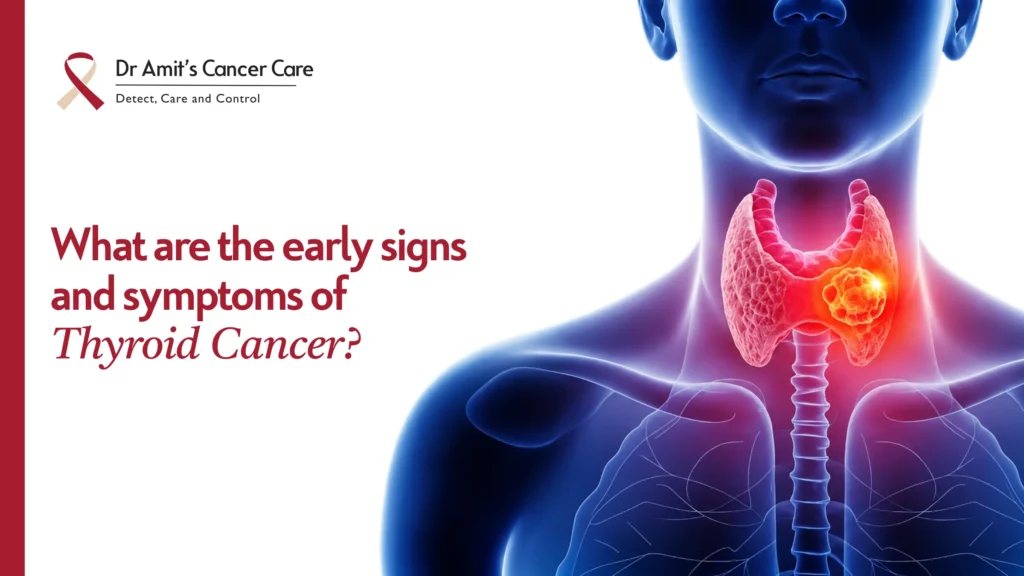
The thyroid is a small butterfly-shaped gland at the front of your neck, just below the Adam’s apple. It controls metabolism, heart rate, body temperature, and energy regulation through the hormones it produces.
When thyroid cells mutate and grow abnormally, thyroid cancer develops. It affects both men and women, though it is diagnosed more frequently in women. The encouraging reality is that most thyroid cancers, particularly when identified early, respond very well to treatment.
Early Signs of Thyroid Cancer to Watch Out For
A Lump or Nodule in the Neck
The most common early indicator. It typically appears at the front of the neck and may feel firm. It is usually painless, which is precisely why it gets ignored. Most thyroid nodules are benign. However, any nodule that persists, grows, or feels hard warrants medical evaluation without delay.
Unexplained Hoarseness or Voice Changes
When a thyroid growth presses on the recurrent laryngeal nerve, it can alter the voice. Hoarseness that has no respiratory explanation and does not clear up is worth investigating.
Difficulty Swallowing
A persistent sensation of pressure or food catching in the throat can occur when a nodule presses on the oesophagus. This is often mistaken for reflux or anxiety.
A Feeling of Tightness or Pressure in the Throat
Even before breathing is visibly affected, patients often describe a vague, persistent tightness. This discomfort is frequently dismissed for months before investigation.
Swollen Lymph Nodes That Do Not Resolve
Enlarged lymph nodes in the neck that are not linked to infection and that do not reduce over two to four weeks can indicate spread to surrounding tissue.
Persistent Neck or Throat Pain
Ongoing pain at the front of the neck, sometimes extending toward the jaw or ears, without an obvious cause.
Different Symptoms Depending on The Type of Thyroid Cancers
Not all thyroid cancers behave the same way. Understanding the type can help explain the symptom pattern.
Papillary Thyroid Cancer
The most common form representing the majority of diagnoses. It tends to grow slowly and often presents as a painless neck lump. It does spread to cervical lymph nodes, but the long-term prognosis is good with appropriate treatment.
Follicular Thyroid Cancer
This type tends to spread via the bloodstream rather than lymph nodes, meaning distant metastasis to lungs or bone can occur before local symptoms appear. Early signs are similar to papillary and are easy to overlook.
Medullary Thyroid Cancer
It starts in a different set of cells in the thyroid, ones that produce a hormone called calcitonin rather than the usual thyroid hormones. This causes symptoms you might not immediately connect to your thyroid, including persistent diarrhoea, sudden facial flushing, and a noticeable lump in the neck.
One important thing to know: roughly 1 in 4 cases of medullary thyroid cancer run in families. If a close relative has been diagnosed with it, book a consultation with your doctor. You may qualify for genetic testing that can catch problems before symptoms even appear.
Differentiated Thyroid Cancer
This category includes both papillary and follicular types. Most cases are caught at early stages and have high survival rates. Symptoms mirror those listed above.
Thyroid Cancer Symptoms in Females
Thyroid cancer is significantly more common in women, with diagnosis rates nearly three times higher than in men. Despite this, symptoms are frequently attributed to hormonal fluctuations, stress, or thyroid conditions like hypothyroidism, which delays investigation.
Women should pay particular attention to:
- A neck lump that appears or changes around pregnancy or postpartum
- Voice changes or swallowing difficulty that coincides with hormonal shifts
- Persistent fatigue that does not improve with rest or thyroid medication
- Neck swelling that is dismissed as a goitre without proper imaging
The overlap between thyroid cancer symptoms and common hormonal conditions in women is the single biggest reason diagnoses are delayed. If you have an existing thyroid condition and notice any new or changing symptoms, do not assume it is the same problem. Get it re-evaluated.
Women with a family history of thyroid cancer, those who have had prior radiation exposure to the neck, and women between 25 and 50 are in the highest risk category and should be especially vigilant.
Thyroid Cancer Symptoms in Males
Thyroid cancer is diagnosed less frequently in men. Unfortunately, when it does present, it’s at a more advanced stage. Men are statistically less likely to seek early investigation for neck changes, which contributes to later detection.
Specific symptoms to watch for in males include
- a rapidly growing neck nodule
- unexplained voice changes
- difficulty swallowing that progressively worsens.
Any of these in a male patient over 40 with no obvious cause should be investigated promptly.
Stage 2 and Advanced Thyroid Cancer Symptoms
As thyroid cancer progresses, symptoms become much more noticeable.
Stage 2 symptoms may include a visibly
- enlarged thyroid
- more persistent swallowing difficulty
- voice changes that are noticeable to others.
Advanced thyroid cancer symptoms can include:
- Significant breathing difficulty
- Bone pain if metastasis has occurred
- Persistent cough unrelated to respiratory illness
- Visible neck swelling or deformity
- Unexplained weight loss and fatigue
When Should You See a Doctor?
See a doctor promptly if you notice:
- Any neck lump or nodule that persists beyond two to three weeks
- Voice changes lasting more than three weeks without a clear cause
- Swallowing difficulty that is new or progressively worsening
- Swollen lymph nodes in the neck are not linked to infection
- A family history of medullary thyroid cancer or MEN2 syndrome
At Dr Amit’s Cancer Care, early investigation typically involves a physical examination, thyroid ultrasound, and a TSH blood test. If a nodule is identified, a fine needle aspiration biopsy may follow. None of these is invasive, and early investigation is always worth the appointment.
Final Thoughts
Thyroid cancer is not loud. It does not announce itself with dramatic symptoms in its early stages. What it does do is leave signals, a lump, a changed voice, a persistent tightness, that are easy to rationalise away.
Follow this simple rule: if something in your neck feels different and stays different, get it checked. Prioritise your health concerns when you notice them; this step could be the most important health decision you make for yourself.
If you have any further questions, feel free to reach out to us. at +91 – 86577 17988 An early conversation is always best when it comes to our health matters.
References
- Wajid Sayed, Osama A. Samarkandi, Ahmed Alsadoun, Mohammed K. Al Harbi, Mahmood Basil A. Al Rawi, 2022, Evaluation of clinical knowledge and perceptions about the development of thyroid cancer An observational study of healthcare undergraduates in Saudi Arabia, availble at, https://www.frontiersin.org/journals/public-health/articles/10.3389/fpubh.2022.912424/full
- Jolanta Krajewska, Aleksandra Kukulska, Malgorzata Oczko-Wojciechowska, Malgorzata Haras-Gil, Agnieszka Kotecka-Blicharz , Katarzyna Drosik-Rutowicz, Barbara jarzab,Daria Handkiewicz-Junak, 2020,Early Diagnosis of Low-Risk Papillary Thyroid Cancer Results Rather in Overtreatment Than a Better Survival, availble at, https://www.frontiersin.org/journals/endocrinology/articles/10.3389/fendo.2020.571421/full



 Aug 26, 2025