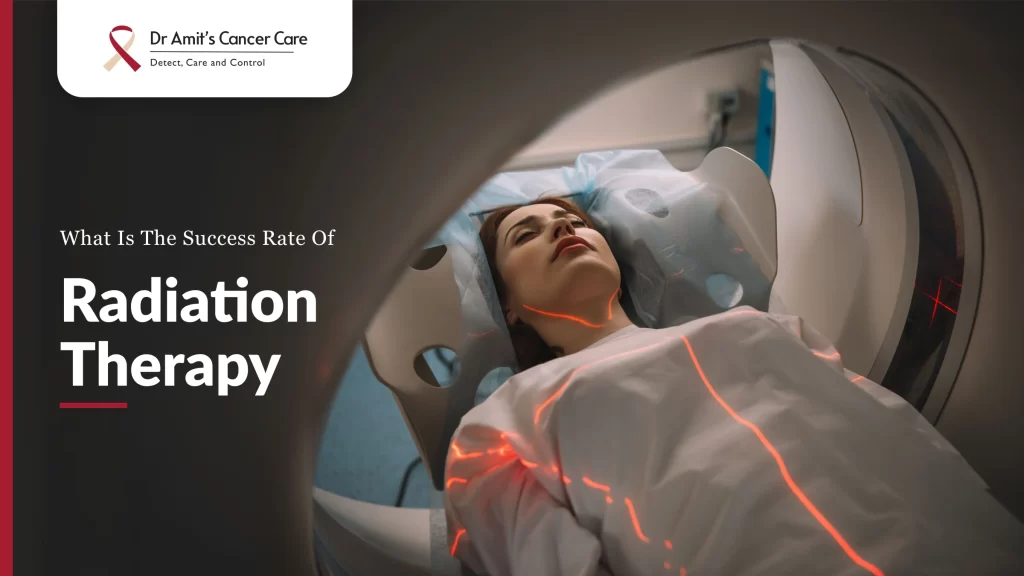

You have been told you need radiation.
Your next question is direct: What is the success rate of radiation therapy? Not reassurance. Not optimism. You want numbers. You want context. You want to know whether radiation alone will cure the disease and whether your speech, swallowing, and identity will remain intact.
In head and neck cancers, radiation therapy success rate depends on stage, tumour biology, location, and whether treatment is delivered alone or as part of a coordinated plan.
In this article, you will understand:
- What “success rate” medically means
- How outcomes vary by stage and tumour site
- The difference between cure rate, local control, and survival statistics
- When radiation works as primary treatment
- When it is used after surgery
- What realistic side effects look like
Read this with one goal: For clarity.
What Does “Success Rate” Mean in Radiation Therapy?
When you search, what is the success rate of radiation therapy? You expect a percentage.
Medicine does not use one single number. It uses defined outcome measures. Each answers a different question.
In head and neck oncology, the term radiation therapy success rate may refer to one of the following:
- Local control rate – Has the tumour disappeared at the original site?
- Regional control rate – Are neck lymph nodes free of disease?
- Disease-free survival – Is the patient alive without recurrence at a defined time point, usually 3 or 5 years?
- Overall survival – Is the patient alive at 5 years, irrespective of cause?
- Organ preservation rate – Has the larynx, tongue, or related structure been preserved without removal?
These are not interchangeable.
For example:
A patient may achieve local control the tumour shrinks completely after radiation yet still faces recurrence in lymph nodes later. That is local success, but not disease-free survival.
Similarly, a survival percentage does not tell you whether speech remained intact or swallowing required long-term support.
In early-stage laryngeal cancer, radiation may offer local control rates exceeding 85–90%. That does not automatically translate into the same numbers for advanced oral cavity cancers.
So when someone quotes a cancer radiation therapy success rate, pause. Ask:
- Which stage?
- Which subsite?
- Radiation alone or combined with surgery or chemotherapy?
- At what time point 2 years, 5 years, 10 years?
Clarity begins with defining the metric.
How Stage and Tumour Subsite Change Outcomes
When patients ask how successful is radiation therapy, the honest answer is: it depends on where the cancer is and how far it has spread.
Head and neck cancers are not one disease. A stage I vocal cord tumour behaves very differently from a stage III buccal mucosa cancer. The biology, radiation sensitivity, and likelihood of recurrence vary by subsite.
Let us look at this with clarity.
a. Early-Stage Disease (Stage I–II)
In carefully selected early tumours:
- Early laryngeal cancer (vocal cord)
Radiation alone can achieve local control rates of 85–95%. Voice preservation rates are high. - Early oropharyngeal cancer (HPV-positive)
Outcomes are favourable, with high disease-free survival when treated appropriately. - Early oral cavity cancers
Surgery is often preferred. Radiation may be used in selected situations but is not the primary curative modality in most cases.
At this stage, the radiation therapy success rate can be strong but only when staging is precise and patient selection is appropriate.
b. Locally Advanced Disease (Stage III)
As stage increases, outcomes change:
- Tumours may infiltrate muscle, bone, or multiple lymph nodes.
- Radiation alone may not be sufficient.
- Combined treatment surgery followed by radiation, or radiation with chemotherapy becomes necessary.
In stage III disease, overall 5-year survival may range between 50–70% depending on site and biological factors. But survival does not automatically mean preserved swallowing or speech.
C. Why Subsite Matters
- Larynx: Radiation can preserve the organ in many early cases.
- Oral cavity: Surgery usually forms the foundation of cure; radiation supports high-risk features.
- Oropharynx: HPV status significantly alters prognosis.
- Thyroid cancer: External radiation is rarely first-line; surgery dominates management.
When evaluating the success rate of radiation therapy, you must align the number with your specific stage and subsite. A generic statistic offers false confidence. A stage-matched plan offers clarity.
Cure Rate vs Local Control vs Survival (Do Not Confuse These)
When you read about the radiation therapy success rate, you will see different percentages quoted in articles, hospital websites, and research papers. They often refer to different endpoints. If you do not separate these clearly, the numbers mislead you.
Let us define them precisely.
a. Cure Rate
A cure implies long-term absence of disease without recurrence.
In oncology, we often use 5-year disease-free survival as a practical marker of cure, though follow-up may continue beyond that.
For example:
If 90 out of 100 patients with early-stage vocal cord cancer remain disease-free at 5 years after radiation, the functional cure rate approximates 90%. But that figure applies only to that stage and that subsite.
b. Local Control
Local control means the tumour at its original site disappears and does not regrow within a defined follow-up period.
It does not automatically include:
- Neck lymph node recurrence
- Distant metastasis
You may see a high cancer radiation therapy success rate quoted based on local control alone.
Ask whether nodal control and distant spread were included in that statistic.
c. Disease-Free Survival (DFS)
Disease-free survival measures the percentage of patients alive without any detectable cancer at a specific time point, often 3 or 5 years. DFS is more meaningful than local control because it accounts for recurrence anywhere in the body.
d. Overall Survival (OS)
Overall survival measures how many patients are alive at a given time regardless of whether cancer has recurred or what caused death. This number may be lower than local control rates. It reflects broader health variables, age, comorbidities, and tumour aggressiveness.
When you ask, What is the success rate of radiation therapy? Clarify which of these metrics your doctor is referring to.
A single percentage does not capture:
- Functional outcome
- Recurrence pattern
- Long-term swallowing ability
- Voice quality
In head and neck oncology, survival and identity are separate endpoints. Both matter.
When Is Radiation Used as the Primary Treatment?
Radiation is not automatically the first treatment for every head and neck cancer. Its role depends on tumour location, stage, expected functional outcome, and long-term control rates.
When patients ask how successful is radiation therapy, they often mean:
Can I avoid surgery? The answer is site-specific.
a. Situations Where Radiation May Be Primary Treatment
1. Early-stage laryngeal cancer (T1–T2 vocal cord tumours)
Radiation alone can achieve high local control rates, often 85–95%. The larynx remains structurally intact. Voice preservation is possible in many patients. In these cases, the radiation therapy success rate is comparable to surgery, with the advantage of organ preservation.
2. Selected oropharyngeal cancers
Especially in HPV-positive tumours, radiation often combined with chemotherapy may serve as definitive treatment.
3. Patients unfit for surgery
Where anaesthesia risk is high or tumour location makes surgery morbid, radiation becomes the safer curative approach.
b. When Radiation Alone Is Not Enough
For many oral cavity cancers tongue, buccal mucosa, floor of mouth surgery remains the foundation of cure.
Radiation alone in these settings may reduce tumour size but may not achieve durable control in stage II–III disease. In such cases, relying solely on a quoted success rate of radiation therapy without considering surgical benefit can compromise long-term outcomes.
c. What Determines Primary Radiation Decision?
A responsible decision includes:
- Tumour size and depth
- Nodal involvement
- Expected speech and swallowing outcome
- Patient age and general health
- Long-term functional preservation
Radiation as primary therapy works best when chosen deliberately not by default.
When Is Radiation Given After Surgery? (Adjuvant Setting)
In many head and neck cancers, surgery removes the visible tumour first. Radiation follows. Not as backup. Not as routine. But for a defined purpose. This is called adjuvant radiation therapy.
Radiation after surgery does not mean surgery failed. It means we are reducing recurrence risk.
a. Why Add Radiation After Surgery?
We recommend post-operative radiation when pathology shows higher-risk features such as:
- Positive or close surgical margins
- Multiple involved lymph nodes
- Extracapsular spread in lymph nodes
- Perineural invasion
- Lymphovascular invasion
- Large primary tumour size (T3–T4)
In these situations, surgery removes the tumour you can see. Radiation treats microscopic disease you cannot.
b. How Does This Influence Outcomes?
Adjuvant radiation:
- Improves local and regional control
- Reduces recurrence risk
- Improves disease-free survival in selected stages
In stage III oral cavity cancers, combined surgery followed by radiation offers significantly better control than radiation alone.
So when someone quotes a standalone radiation therapy success rate, ask: Was it radiation alone or part of combined treatment?
c. Does Chemotherapy Get Added?
In certain high-risk cases, chemotherapy is added to radiation after surgery.
This is called concurrent chemoradiation. It increases control rates but also increases toxicity. The decision must be individualised.
In specialised head and neck practice, adjuvant radiation is not automatic. It is stage-matched and pathology-driven. A coordinated tumour board review ensures radiation is used where it improves outcomes and avoided where it does not add benefit.
Realistic Side Effects and Long-Term Functional Considerations
When evaluating the radiation therapy success rate, do not look at survival numbers alone. Ask what happens to speech. Swallowing. Saliva. Jaw movement.
Radiation works by targeting rapidly dividing cancer cells. Normal tissues in the treatment field are affected too. The impact depends on dose, field size, concurrent chemotherapy, and baseline function.
Short-Term Effects (During or Shortly After Treatment) most patients experience:
- Oral mucositis painful ulceration of the lining of the mouth
- Dry mouth
- Altered taste
- Skin darkening or irritation in the treated area
- Fatigue
- Difficulty swallowing
These are expected. They peak toward the end of treatment and gradually improve over weeks.
a. Long-Term Effects (Months to Years Later)
Long-term effects are more relevant when asking how successful is radiation therapy in preserving quality of life.
Possible long-term concerns include:
- Persistent dry mouth due to salivary gland damage
- Swallowing difficulty from fibrosis
- Reduced jaw opening (trismus)
- Dental complications
- Voice changes
- Rarely, cartilage damage in the larynx
Not every patient develops these. Risk increases with higher radiation dose and combined chemotherapy.
b. Functional Preservation Is Not Automatic
Modern radiation techniques IMRT and image-guided therapy allow better sparing of normal tissue. But technology alone does not guarantee preserved function.
Outcomes improve when:
- Radiation fields are carefully planned
- Surgery is tissue-preserving where possible
- Speech and swallowing therapy begins early
- Nutritional planning is integrated
- Multidisciplinary follow-up is structured
The true cancer radiation therapy success rate in head and neck disease must include functional survival not just tumour control.
For many patients, the question is not only “Will I live?” It is “Will I speak normally? Will I eat without difficulty? Will I return to work?”
These questions must shape treatment planning from the start.
Common Misconceptions About Radiation Therapy
When you search, what is the success rate of radiation therapy? You may encounter oversimplified claims. Some overstate benefits. Others exaggerate harm. Both create confusion.
Let us address frequent misconceptions directly.
Misconception 1: Radiation Works the Same for Every Cancer
It does not.
The radiation therapy success rate differs by:
- Tumour subsite
- Stage
- HPV status in oropharyngeal cancers
- Whether surgery was performed
- Whether chemotherapy is added
A statistic quoted for early vocal cord cancer cannot be applied to stage III oral cavity cancer.
Misconception 2: Radiation Avoids All Functional Damage
Radiation preserves organs structurally. It does not automatically preserve function.
For example:
The larynx may remain intact, yet stiffness and fibrosis may alter voice quality. Salivary glands may partially recover, but dryness can persist. Organ preservation and functional preservation are related but not identical.
Misconception 3: Radiation Alone Is Enough for Advanced Disease
In stage III or high-risk oral cavity cancers, radiation alone may not provide durable control. Combined treatment improves outcomes.
When evaluating the success rate of radiation therapy, ensure the number reflects the correct treatment strategy for your stage.
Misconception 4: Radiation Is Unsafe or “Burns” the Body
Modern radiation is precisely planned. CT-based simulation defines target volumes. Dose is calculated to millimetre accuracy.
Side effects occur, but they are predictable and monitored. Radiation does not circulate through the body after treatment sessions. It is not retained internally.
Misconception 5: If Cancer Returns After Radiation, Nothing Can Be Done
Recurrence patterns differ. Salvage surgery remains possible in selected cases. Early detection improves salvage outcomes. This is why structured follow-up is critical.
Accurate understanding improves decision quality. Overconfidence and unnecessary fear both impair judgement.
Conclusion
The question, What is the success rate of radiation therapy? cannot be answered with a single number.
Success depends on:
- Stage
- Tumour subsite
- Biological behaviour
- Whether radiation is primary or adjuvant
- Whether chemotherapy is added
- Precision of planning
- Long-term functional strategy
Local control is not the same as cure. Survival is not the same as preserved speech or swallowing.
In head and neck cancer, the correct metric is this: Survival with maintained identity.
If you are evaluating radiation therapy as part of your treatment, seek a stage-specific explanation. Ask for numbers aligned to your diagnosis. Request multidisciplinary review.
A clear plan reduces uncertainty. The decision you make now influences not just survival but the way you live after treatment.
If this helped you, don’t keep it to yourself.
Pass it on. Someone in your circle is staring at a diagnosis right now scrolling at midnight, searching for clarity. Your share could be the nudge they need to move forward with a plan, not panic.
And if you’re the one looking for answers, pause here.
Help isn’t far. One message. One call. That’s all it takes. Text us. Or call +91-86577-17988. We’re here. Ready when you are.


 Oct 11, 2024