
It usually begins with something small. A mouth ulcer not healing.
You notice it while brushing. A slight sting. Maybe a burning feeling when you eat something spicy. You tell yourself, “Maybe it’s just a regular ulcer.”
A few days pass. It’s still there.
You run your tongue over it again. Feels rough. Different. There’s a faint patch inside your cheek that wasn’t there before.
Life goes on work calls, deadlines, family responsibilities. You ignore it. Most people do.
But then… it crosses two weeks.
That’s when the thought quietly slips in, “What if this isn’t normal?”
You open your phone late at night and type: “can smoking cause mouth cancer”
And suddenly, the question feels personal. Not general. Not theoretical. About you.
Could your smoking habit actually be the reason this isn’t healing?
What is Mouth Cancer?
Mouth cancer refers to cancer that develops in any part of the oral cavity, including:
- Lips
- Tongue
- Gums
- Inner cheeks
- Roof or floor of the mouth
It is a type of head and neck cancer and can become life-threatening if not detected early.
Does Smoking Cause Mouth Cancer?
Short answer? Yes.
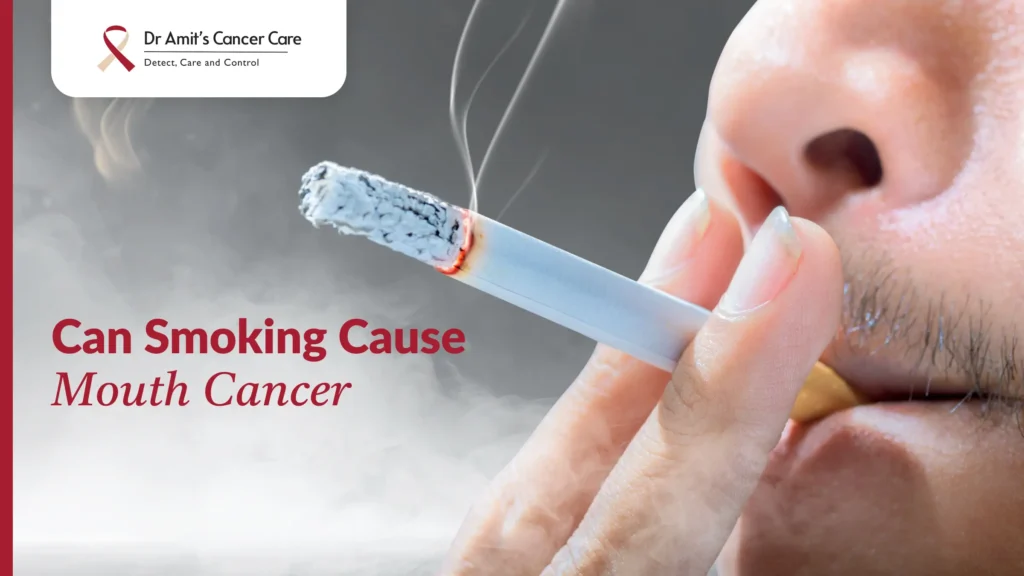
Smoking causes mouth cancer.
Every time you smoke whether it’s cigarettes, bidi, or even smokeless tobacco your mouth is exposed to harmful chemicals. These chemicals don’t just pass through. They stay. They irritate. They damage the cells lining your mouth.
At first, the body tries to repair itself.
But with repeated exposure, those cells begin to change. Slowly. Quietly. And over time, those changes can turn into cancer.
This isn’t limited to heavy smokers. Even moderate, long-term use increases risk. The pattern matters. The duration matters.
And here’s the part most people overlook: It doesn’t always come with pain in the beginning.
That’s why something like a mouth ulcer which does not heal needs attention. It may look small but it can be an early signal your body is struggling to cope with the damage.
The longer and more frequent the habit, the higher the risk. No shortcuts around that. If you’ve been wondering whether smoking and mouth cancer are connected
they are. Directly.
What Smoking Actually Does Inside Your Mouth
It’s not just smoke going in and out.
Every puff brings heat and chemicals that sit directly on the soft lining of your mouth. Over time, this constant exposure starts to change things slowly, quietly.
Here’s how it usually builds:
- First, there’s irritation. A mild burning feeling.
- Then, patches appear white or red areas that feel slightly rough
- You may notice a mouth ulcer not healing, staying longer than usual
- The surface may feel thicker in one spot
- And if this continues unchecked, these changes can turn into cancer
This is how mouth cancer due to smoking often begins not suddenly, but step by step.
You might not even notice the shift at first. There’s no alarm bell. No sharp pain. Just small changes that feel easy to ignore.
But inside, the cells are under constant stress. They’re trying to repair damage again and again. And eventually, that repair process starts going wrong.That’s when normal cells begin to behave abnormally.It doesn’t happen overnight. But it doesn’t stop on its own either.
Early Signs Most People Ignore
Most people don’t miss the signs. They notice them… and then choose to wait.
A small sore. A patch. A little discomfort. “Give it a few days,” you tell yourself.
And then a few more. Here are some early smoking mouth cancer symptoms that often get ignored:
- A mouth ulcer not healing for more than 2 weeks
- White or red patches inside the cheek, tongue, or gums
- Pain or burning while chewing or swallowing
- A lump or thickened area inside the mouth
- A feeling that something is stuck or rough in one spot
- Slight change in voice or discomfort while speaking
None of these feel dramatic at first. That’s the problem.
You adjust. Eat from the other side. Avoid spicy food. Stop thinking about it during the day.But at night, it comes back. That same thought, “Why isn’t this going away?”
Here’s a simple rule most people delay following:If it hasn’t healed in 2 weeks, stop waiting.
Because early signs don’t stay early forever.And catching them at this stage can make all the difference between a simple treatment… and something much more complicated.
You don’t need to panic. But you do need to pay attention.
Who is at Higher Risk?
You may have a higher chance of developing mouth cancer if you:
- Smoke regularly
- Use smokeless tobacco
- Drink alcohol frequently
- Have poor oral hygiene
- Are exposed to HPV (Human Papillomavirus)
- Have a family history of cancer
Combining smoking and alcohol multiplies the risk significantly.
Why Smokers Often Delay Getting Checked
If you’ve been putting it off, you’re not alone.
Most people don’t rush to a doctor the moment they notice something unusual in their mouth. They wait. Watch. Hope it settles on its own.
A few common thoughts usually play in the background:
- “It’s just an ulcer. It’ll go away.”
- “I’ve had this before. Nothing serious.”
- “What if the doctor says something I don’t want to hear?”
There’s also a quiet layer of guilt.
You know smoking isn’t great for health. So a part of you hesitates almost like avoiding confirmation.
Then comes confusion. You search online and find too many answers. Some say it’s harmless. Others say it could be serious. So you do nothing. And honestly, that reaction is human.
But here’s the shift: Waiting doesn’t reduce risk. It only reduces options later.
Getting it checked early doesn’t mean something is wrong. It just means you’re choosing clarity over doubt.
What Happens If You Catch It Early vs Late
This is where timing quietly changes everything.
The difference between early and late detection isn’t just medical, it affects how you live, speak, and eat afterward.
If Mouth Cancer Caught Early
When signs are picked up early, things are usually simpler:
- Smaller area to treat
- Less aggressive procedures
- Faster recovery
- Higher chances of complete cure
- Better preservation of speech clarity and normal swallowing
In many cases, treatment feels manageable. You recover and gradually return to your routine without major disruption.
If Mouth Cancer Caught Late
When it’s delayed, the situation often becomes more complex:
- Larger area involved
- More extensive surgery or combined treatments
- Longer recovery time
- Higher chance of complications
- Greater impact on facial appearance, eating ability, and speaking
This is where people start feeling the real weight of delay. Not just physically but emotionally too.
The Real Difference
The early stage gives you options.
The late stage takes them away.
That’s why something as simple as a non-healing oral sore, a persistent mouth lesion, or a rough patch inside the cheek shouldn’t be brushed aside.
You don’t have to assume the worst.
But you also shouldn’t ignore what your body is trying to show you.
How Modern Treatment Has Changed Outcomes
If the word “cancer treatment” makes you think of long, painful recovery you’re not alone.
But things have changed. Quite a bit.
Today, treatment is more precise. More controlled. And far more focused on helping you return to normal life.
Here’s what’s different now:
- Targeted surgery removes only the affected area instead of large sections
- Better planning helps doctors protect speech function and swallowing ability
- Recovery is more structured, with support at each step
In some cases, doctors use minimally invasive surgery or robotic-assisted techniques.
You don’t need to get into the technical side of it. What matters is what it means for you:
- Smaller cuts
- Less strain on surrounding tissues
- Faster healing
- Better preservation of facial structure and daily function
And then comes rehabilitation something many people don’t expect but truly need:
- Support for speech recovery
- Help with eating and swallowing
- Guidance to get back to daily routines
Treatment today isn’t just about removing disease.
It’s about helping you move forward without losing the parts of life that matter most.
A Quiet but Strong Push to Act
It started as something small. A sore. A patch. A bit of discomfort you thought would pass.
Maybe you’re still telling yourself that. Maybe you’re still waiting. But here’s the thing: small signs don’t stay small forever.
A persistent mouth ulcer, a non-healing sore, or a slight change inside your mouth… These are your body’s early signals. Easy to ignore. Easier to delay.
Until they’re not. You don’t have to assume the worst.You don’t have to panic. But you also don’t have to keep guessing.
Waiting makes it harder. Early action gives you options.
A simple check today can either put your mind at ease… or catch something at a stage where treatment is far easier and recovery smoother.
And if you’ve been thinking about getting it checked that thought itself is a good enough reason to act. If this helped you think differently about that one symptom you’ve been ignoring, there’s a good chance someone else around you might need it too.


 Mar 29, 2025