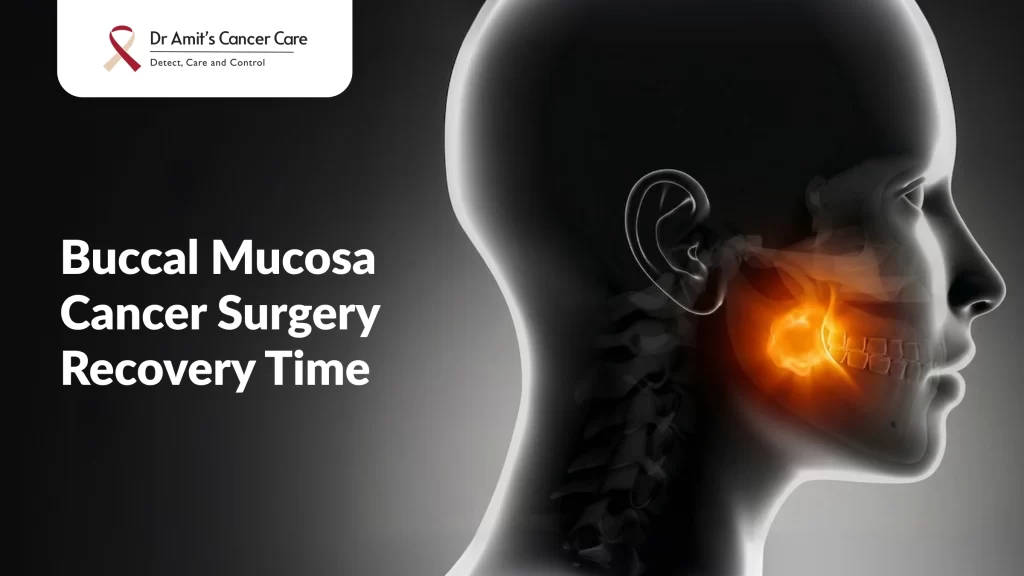

The moment you hear that the ulcer inside the cheek is cancer, the room goes quiet. Reports sit on the table. Family members exchange measured glances. One question moves to the front, “how long will recovery take?”
Understanding Buccal mucosa cancer surgery recovery time helps you plan your leave from work, organise support at home, and prepare for the first few weeks after discharge. It replaces scattered opinions with a structured timeline.
Recovery after buccal mucosa cancer surgery is not the same for everyone. An early-stage tumour confined to the lining of the cheek heals differently from one requiring deeper removal or reconstruction. The need for additional buccal mucosa cancer treatment, such as radiation, also influences pace.
In carefully planned care, surgery is designed to remove disease while protecting speech, swallowing, and facial balance. Clarity before surgery often reduces uncertainty after it.
Understanding Buccal Mucosa Cancer Surgery
When you hear the term buccal mucosa cancer surgery, it may sound technical. In simple terms, it means removing the cancer from the inner lining of the cheek with a clear margin of safety.
If the tumour is detected early, surgery may involve removing only the affected lining and a thin layer of underlying tissue. The defect is often closed directly. Hospital stay is shorter. Recovery is steadier.
If the disease extends deeper into muscle or bone the operation becomes more detailed. Part of the jaw may require treatment. Reconstruction using tissue from another area of the body may be advised to restore contour and movement. This is still part of comprehensive buccal mucosa cancer treatment, not a complication.
Before surgery, imaging, biopsy findings, and staging are reviewed in a multidisciplinary tumour board. Decisions are deliberate. The aim is clear margins with preservation of speech, swallowing, and facial symmetry.
Immediate Post-Operative Phase (0–7 Days)
The first week after surgery is structured. Monitored. Predictable.
On the day of surgery, you wake up in recovery with monitoring lines in place. In early-stage cases, you may shift to the ward the same day. More extensive procedures particularly those involving jaw reconstruction may require a short ICU stay for closer observation.
Typical hospital stay after oral cancer surgery ranges from 3 to 7 days, depending on surgical extent and medical stability. Pain is controlled with scheduled medication. Discomfort is expected. Uncontrolled pain is not.
Swelling inside the cheek peaks around day two or three. Speech may sound unclear at first. This is temporary. If chewing is restricted, a soft or liquid diet is introduced gradually. In selected cases, a temporary feeding tube supports nutrition while healing begins.
During this phase, Buccal mucosa cancer surgery recovery time is focused on three checkpoints:
- Stable vital signs
- Adequate pain control
- Safe swallowing or alternate nutrition plan
Discharge happens only when these criteria are met. You leave with clear instructions on wound care, diet progression and follow-up dates. The first week sets the rhythm for recovery.
Early Recovery at Home (2–4 Weeks)
The hospital environment fades. Home routines return slowly.
During this phase of oral cancer recovery time, healing becomes visible. Swelling reduces week by week. If sutures were placed inside the cheek, many dissolve on their own. Mild tightness while opening the mouth is common. Gentle jaw exercises are introduced early to prevent stiffness.
Eating after oral cancer surgery requires patience. Start with soft foods khichdi, dal, curd, and well-cooked vegetables. Advance gradually. Avoid spicy or coarse textures until the lining strengthens.
If reconstruction was performed, progression may take longer, but structured guidance makes it predictable.
Speech after buccal surgery improves as swelling settles and tongue mobility adjusts. Some words may feel heavier at first. Practice aloud. Short conversations. Then longer ones. Most early-stage cases regain clear speech within weeks.
You may resume light desk work in two to three weeks if healing is steady. Physical exertion should wait longer.
Watch for warning signs:
- Persistent bleeding
- Fever
- Increasing pain
- Difficulty swallowing saliva
Follow-up visits assess wound healing and review final pathology. If additional buccal mucosa cancer treatment such as radiation is required, timelines are discussed clearly. Recovery continues. Methodically.
Long-Term Recovery and Functional Outcomes (1–6 Months)
Beyond the first month, recovery shifts from healing to refinement. In most early-stage cases of cheek cancer surgery, daily activities resume within four to six weeks. Eating becomes more comfortable. Speech steadies. The surgical site inside the mouth softens and adapts. What felt tight in week two often feels natural by month three.
If reconstruction was required, adaptation takes longer not unpredictably, but progressively.
Structured speech therapy improves articulation. Swallowing exercises strengthen coordination. This phase of oral cavity cancer recovery is active. You participate in it.
If radiation is part of treatment, temporary dryness of mouth or altered taste may occur. Nutritional planning and regular follow-up help manage these effects.
By three to six months, most patients return to professional and social settings with minimal functional limitation. The scar inside the cheek matures. Facial balance stabilises. Recovery is not abrupt. It is incremental built through surgical precision, rehabilitation, and consistent review.
Factors That Influence Buccal Mucosa Cancer Surgery Recovery Time
Not all recoveries follow the same clock. The variation is clinical, not random.
Several factors influence Buccal mucosa cancer surgery recovery time:
- Tumour stage: Early lesions confined to the inner lining heal faster than deeper tumours.
- Extent of resection: Involvement of muscle or jaw bone increases recovery duration.
- Type of reconstruction: Direct closure differs from flap reconstruction.
- General health: Diabetes, anaemia, or cardiac conditions may slow wound healing.
- Tobacco cessation: Continued use delays tissue repair.
- Adherence to rehabilitation: Speech and jaw exercises shorten stiffness and improve outcomes.
Clarity about these variables helps set realistic timelines from the beginning.
How Structured Planning Reduces Uncertainty
Uncertainty reduces when the sequence is clear.
Before surgery, imaging, biopsy findings, and staging are reviewed in a multidisciplinary tumour board. Surgical planning is deliberate. Margins are mapped. Reconstruction options are discussed in advance. You are told what the first week will involve, how long hospital stay may be, and when oral intake begins.
This structure directly influences recovery time of buccal mucosa cancer surgery. Fewer surprises mean smoother transitions.
Rehabilitation is not introduced late. Jaw exercises, speech guidance, and nutritional planning begin early. Follow-up dates are fixed before discharge.
Predictability stabilises recovery. You know the next step before it arrives.
Practical Recovery Timeline Snapshot
Below is a simplified view of Buccal mucosa cancer surgery recovery. Individual variation applies, but the sequence remains structured.
| Timeframe | Expected Course / Milestones |
| Day 1–3 | Monitoring in ICU or ward; swelling peaks; liquid or tube feeding if required |
| Day 4–7 | Transition to soft oral intake; pain controlled with oral medication; discharge once swallowing is safe |
| Week 2 | Swelling reduces; jaw exercises continue; short conversations feel easier |
| Week 4 | Soft-to-regular diet progression; light work may resume |
| Month 3 | Speech clarity stabilises; scar tissue softens |
| Month 6 | Functional recovery largely complete in early-stage cases |
Conclusion
You now see the full arc of Buccal mucosa recovery time. From the first monitored hours in hospital… to soft foods at home… to steady speech and confident meals months later.
Recovery follows a sequence: stabilise, heal, rehabilitate and refine. Stage, extent of surgery, reconstruction, and additional buccal mucosa cancer treatment shape the pace, but the pathway remains structured.
Recovery is not guesswork. It is planned. When surgery protects speech, swallowing, and facial balance and when rehabilitation begins early, return to routine becomes measurable, not uncertain.
Ask direct questions. Request a stage-specific timeline. Understand what your first week, first month, and third month will look like. A personalized consultation turns broad estimates into a clear plan.
Cancer treatment is about removing disease. Recovery is about preserving identity. The real question is not only how long will it take but how well will you return to yourself?
Found this blog helpful? Pass it on to a friend, family member, or colleague.
You never know who’s searching for this exact information or who doesn’t even know where to start.


 Jul 01, 2024