
Salivary gland cancer is when the cancerous lump develops in the salivary gland. It may be a painless swelling at the start which is often discovered during a routine dental check-up. Sometimes, it may be linked with difficulty in swallowing or opening the mouth.
This painless swelling can be diagnosed as a cancerous tumour through tests such as biopsy and ultrasound scans for which surgery, chemotherapy and radiotherapy may be one of the best treatment options.
What is Salivary Gland Cancer?
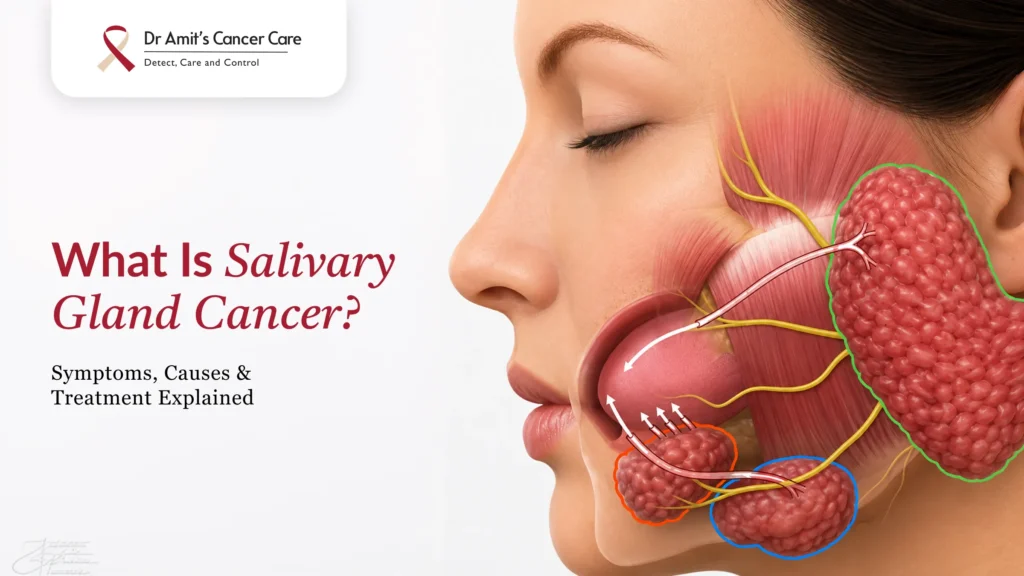
Salivary gland cancer is a rare condition that refers to tumours (mass of cells) that are cancerous in nature that develop in your salivary glands that are present in your mouth and throat and produce saliva, commonly called “spit”, which is important for producing digestive enzymes.
There are three major salivary glands in the human body, from which salivary gland cancer is more likely to develop in the parotid gland, leading to parotid gland cancer. Sometimes, it may develop in the other major salivary glands, which are submandibular and sublingual.
Still, salivary gland cancers are rare, accounting for less than 5% of all malignancies (cancers) of the head and neck region. (Locati, L.D., et al. 2023)
Symptoms of Salivary Gland Cancer
Salivary gland cancer symptoms include a painless, lump-like swelling on a salivary gland which may be noticed in a routine dental checkup or test.
Other symptoms and signs of salivary gland cancer include:
- Loss of sensation or weakness in your face, jaw, mouth, or neck.
- Long-standing pain in your face, jaw, mouth or neck
- Difficulty in movement of facial muscles
- Difficulty in opening your mouth
- Difficulty in swallowing
- Loss of blood from your mouth
- Loss of fluid from your ears
Causes of Salivary Gland Cancer
The actual salivary gland cancer cause is still unknown. However, there are many factors, such as genetic mutation (changes in genes), that may be one of the causative factors that lead to salivary gland cancer. (American Cancer Society)
A few specific research-backed salivary gland cancer causes are as follows:
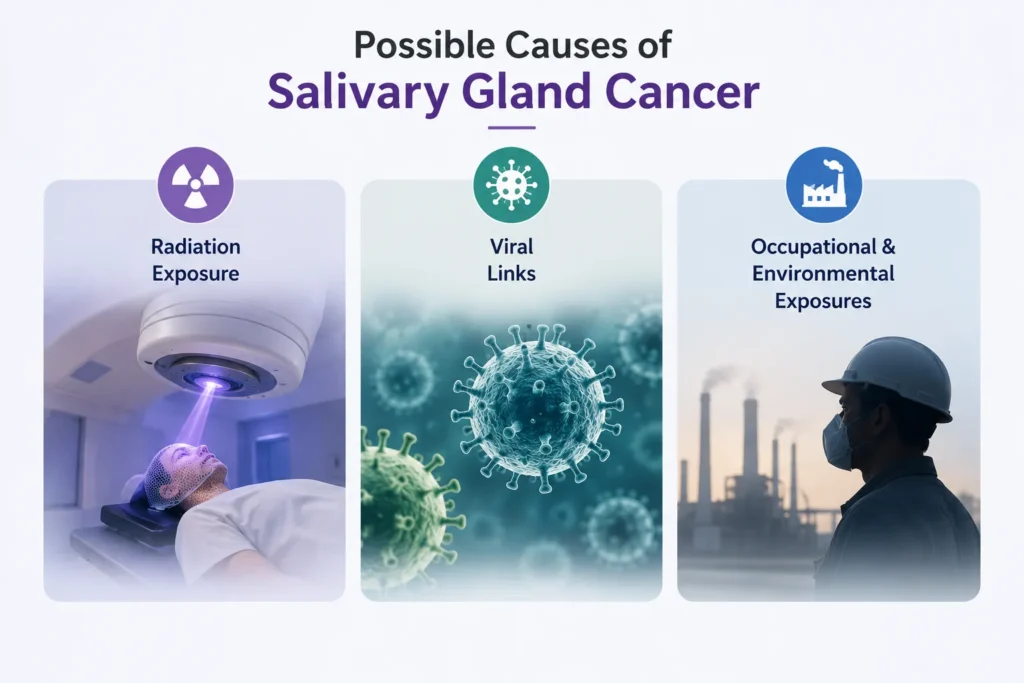
Radiation exposure
Moreover, prior head and neck radiotherapy is one of the more consistently reported causes.
Viral links
Certain high-risk HPV strains have been detected in some mucoepidermoid cancers (a type of salivary gland cancer), HIV infection has been associated with increased risk (likely via immune suppression), and Epstein–Barr virus is specifically linked to a rare subtype of salivary gland cancer called the lymphoepithelial carcinoma. (Pan, S.Y., 2017)
Occupational and environmental exposures
Many occupational and environmental exposures, such as certain chemicals, can be one of the causative factors.
If you or your loved one is suffering from any of these symptoms, it is important to get a detailed assessment. Dr. Amit Chakraborty is an oncologist specialised in head and neck cancer treatment in Mumbai, offering detailed personalised assessment and treatment.
If you or your loved one has concerns about salivary gland cancer, early evaluation can help clarify the diagnosis and guide the right treatment approach. Dr. Amit Chakraborty and his team provide personalised assessment and comprehensive care for head and neck cancers.
Salivary Gland Cancer Risk Factors
The risk factors of salivary gland cancer are the ones which can increase the chances of the occurrence of salivary gland cancer in an individual. They include:
Age
Risk rises steadily with age, and most patients are diagnosed in their 50s and 60s.
Gender
Salivary gland cancer occurs somewhat more often in men than women.
Radiation exposure
Either through prior medical radiotherapy to the head/neck or occupational exposure to radioactive materials.
Occupational exposures
Nickel alloy dust, silica dust, asbestos, and work in rubber manufacturing, plumbing, or certain woodworking trades have all shown possible links. (Straif, K., et al. 2019)
Tobacco and heavy alcohol use
More strongly linked to risk in men in some cohort data.
Diet
Some studies suggest diets low in vegetables and high in animal fat may modestly raise risk. (Pan, S.Y., 2017)
Viral infections
HIV, EBV, and high-risk HPV strains, as noted above.
Family history
Uncommon, but a possible genetic component has been suggested.
None of these risk factors guarantee you’ll develop salivary gland cancer, but if you find yourself linked with more than one risk factors of salivary gland cancer, particularly age plus a history of head/neck radiation, it is important for you to get a health check-up soon.
Types of Salivary Gland Cancer
Salivary gland cancer types are usually classified on the basis of the specific cells where the tumour develops. They are as follows:
| Type of Salivary Gland Cancer | What You Should Know |
| Mucoepidermoid Carcinoma (MEC) | The most common salivary gland cancer, accounting for nearly one-third of cases. It may be low-, intermediate-, or high-grade. |
| Adenoid Cystic Carcinoma (ACC) | The second most common type. Although it usually grows slowly, it has a tendency to spread along nerves (perineural invasion) and may reoccur after many years of treatment. |
| Acinic Cell Carcinoma | A relatively slow-growing cancer that most often develops in the parotid gland. It generally is easier to treat when diagnosed and treated early. |
| Salivary Duct Carcinoma | A rare but highly aggressive cancer that behaves more like aggressive breast or prostate cancer and often requires intensive treatment. |
| Carcinoma ex Pleomorphic Adenoma | A cancer that develops from a long-standing benign pleomorphic adenoma (a slow-growing, non-cancerous salivary gland tumour) Although uncommon, it highlights the importance of evaluating salivary gland lumps. |
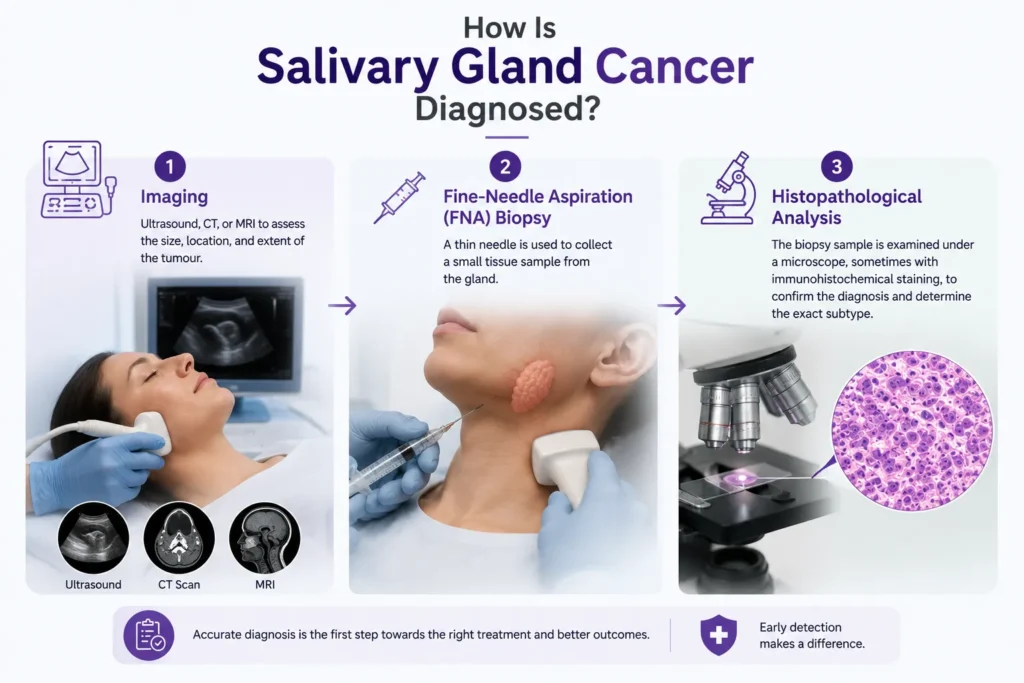
How Is Salivary Gland Cancer Diagnosed?
Diagnosis of salivary gland cancer can be done using biopsy, imaging techniques and histopathological analysis.
If Dr. Amit Chakraborty suspects salivary gland cancer based on your symptoms and a physical exam, the salivary gland cancer test may include:
Imaging
Ultrasound, CT, or MRI to assess the size, location, and extent of the tumour
Fine-needle aspiration (FNA) biopsy
A thin needle is used to collect a small tissue sample from the gland.
Histopathological analysis
The biopsy sample is examined under a microscope (sometimes with immunohistochemical staining) to confirm the diagnosis and determine the exact subtype. (Stawarz, K., et al., 2025)
Salivary Gland Cancer Treatment
Treatment of salivary gland cancer majorly includes surgery, chemotherapy and radiotherapy.
Furthermore, the salivary gland cancer treatment depends on the tumour type, grade, stage, and location, which is why a personalised treatment plan matters more here than in many other cancers. The current therapies are as follows:
1. Surgery
Surgical removal of the tumour is an essential part of the treatment for the salivary gland malignancies, and in many low-grade or early-stage cases, surgery alone may be enough.
2. Radiotherapy
Radiation therapy is frequently used after surgery (adjuvant radiotherapy) to reduce the risk of recurrence, particularly for higher-grade tumours or those with nerve involvement, such as adenoid cystic carcinoma.
3. Chemotherapy and Systemic Therapy
Chemotherapy is generally reserved for advanced, recurrent, or metastatic disease (cancer which has spread to other organs as well). Many salivary gland cancers respond poorly to standard chemotherapy agents compared with other cancer types.
4. Targeted and Emerging Therapies
Because researchers have identified specific gene mutations (abnormal changes in genes) associated with salivary gland cancer subtypes, targeted therapy and immunotherapy may be helpful in treating them, for which research is in progress. (Chabrillac, E., et al., 2024)
5. Post-Treatment Monitoring
Since salivary gland cancer has a higher recurrence (especially with adenoid cystic carcinoma), which may occur years after initial treatment, structured long-term follow-up and surveillance imaging are considered an essential part of the overall treatment plan.
Outcomes are consistently better with early diagnosis and treatment.
Learn more about salivary gland cancer from Dr. Amit Chakraborty.
Salivary Gland Cancer – Causes, Symptoms & treatment Explained by Dr. Amit Chakraborty
If you’d like to discuss a personalised treatment approach, book a consultation with Dr. Amit Chakraborty to review your specific case.
Salivary Gland Cancer Prognosis
The prognosis (outcomes) of the salivary gland cancer are linked with the types of salivary gland cancer and even certain risk factors. The effect on the outcome of the treatment may depend on the following factors:
| Factor | Effect on Outcome |
| Mucoepidermoid Carcinoma | Generally associated with better long-term survival than adenoid cystic carcinoma. |
| Adenoid Cystic Carcinoma | Higher risk of late recurrence, even years after successful treatment. |
| Age >60 years | Associated with a poorer prognosis. |
| Male Sex | Linked to less favourable outcomes compared with females. |
| Advanced Stage at Diagnosis | Significantly reduces survival and usually requires more extensive treatment. |
| Surgical Treatment | Consistently associated with improved survival whenever the tumour is suitable for surgery. |
When Should You See a Specialist?
If you notice a persistent lump near your jaw, ear, or mouth, especially one that doesn’t decrease and is associated with numbness, facial weakness, or difficulty swallowing, it’s time for a professional evaluation.
Dr. Amit Chakraborty is a specialised leading head and neck oncosurgeon who has successfully treated many patients, including the ones suffering from salivary gland cancers.
Schedule your consultation today or explore more on head and neck cancer care to understand your options.
Dr. Amit Chakraborty, a leading Head and Neck Oncosurgeon, provides specialised evaluation and treatment for salivary gland cancers, with personalised care for every patient.
References
- Saleh, E. and Ukwas, A., 2023. Adenoid Cystic Carcinoma of Salivary Glands: A Ten‐Year Review and an Assessment of the Current Management, Surgery, Radiotherapy, and Chemotherapy. International Journal of Otolaryngology, 2023(1), p.7401458.
- Locati, L.D., Ferrarotto, R., Licitra, L., Benazzo, M., Preda, L., Farina, D., Gatta, G., Lombardi, D., Nicolai, P., Vander Poorten, V. and Chua, M.L.K., 2023. Current management and future challenges in salivary glands cancer. Frontiers in oncology, 13, p.1264287.
- Stawarz, K., Durzynska, M., Gałązka, A., Gorzelnik, A., Zwolinski, J., Paszkowska, M., Bieńkowska-Pluta, K. and Misiak-Galazka, M., 2025. Current landscape and future directions of therapeutic approaches for adenoid cystic carcinoma of the salivary glands. Oncology Letters, 29(3), p.153.
- American Cancer Society (citing peer-reviewed epidemiological research). Causes, Risk Factors, and Prevention of Salivary Gland Cancer.
- Pan, S.Y., de Groh, M. and Morrison, H., 2017. A case‐control study of risk factors for salivary gland cancer in Canada. Journal of cancer epidemiology, 2017(1), p.4909214.
- Straif, K., Weiland, S.K., Bungers, M., Holthenrich, D. and Keil, U., 1999. Exposure to nitrosamines and mortality from salivary gland cancer among rubber workers. Epidemiology, 10(6), pp.786-787.
- Chintakuntlawar, A.V., Okuno, S.H. and Price, K.A., 2016. Systemic therapy for recurrent or metastatic salivary gland malignancies. Cancers of the Head & Neck, 1(1), p.11.
- Chabrillac, E., Vergez, S., Barry, B., Jegoux, F., Verillaud, B., Dang, N.P., Baujat, B. and Fakhry, N., 2024. Post-treatment monitoring of salivary gland cancer: REFCOR recommendations by the formal consensus method. European Annals of Otorhinolaryngology, Head and Neck Diseases, 141(6), pp.339-341.


 Aug 20, 2024